
Goal
Construct the standard axis-aligned ellipse equation from a center and positive horizontal and vertical semiaxes.
Worldwide context
Saved once here, used across the site.
Currency changes display only. Country selection guides tax input; no tax rate is guessed.
Construct the standard axis-aligned ellipse equation from a center and positive horizontal and vertical semiaxes.
(x-h)^2/a^2 + (y-k)^2/b^2 = 1, where a remains the horizontal semiaxis and b remains the vertical semiaxis.A clearer path to an answer
This page keeps the calculation transparent: define the goal, enter the matching values, inspect the method, and decide what the result means in your situation.
Construct the standard axis-aligned ellipse equation from a center and positive horizontal and vertical semiaxes.
Center h · Center k · Horizontal semiaxis a · Vertical semiaxis b
(x-h)^2/a^2 + (y-k)^2/b^2 = 1, where a remains the horizontal semiaxis and b remains the vertical semiaxis.
Calculate, review the assumptions below, then compare a related tool when the decision needs more context.
Construct the standard axis-aligned ellipse equation from a center and positive horizontal and vertical semiaxes.
Open the Ellipse Standard Form pageMore math tools
Download PDFDownload Word (.doc)
Enter your values above and choose Calculate to see the result here.
Calculation map
(x-h)^2/a^2 + (y-k)^2/b^2 = 1, where a remains the horizontal semiaxis and b remains the vertical semiaxis.
Bounded, transparent calculation
Your recent runs stay in this browser session only.
Formula: (x-h)^2/a^2 + (y-k)^2/b^2 = 1, where a remains the horizontal semiaxis and b remains the vertical semiaxis.
Translate the origin to the center, divide the squared horizontal displacement by a^2 and the squared vertical displacement by b^2, and set their sum to one. The axes are not reordered by length, so horizontal and vertical meaning is preserved.
Worked example: The standard equation is (x-2)^2/25 + (y+3)^2/4 = 1, with horizontal semiaxis 5 and vertical semiaxis 2.
The displayed limits are checked before the handler runs. Model-specific domain checks may also reject impossible or non-finite inputs.
Methodology: This calculator follows the WorldCalculate input, formula, precision, and boundary policy. Read the official methodology.
Calculator usage statistics
This section counts anonymous successful Calculate submissions, not unique visitors. Counts and top tools appear only when trusted aggregate data is available; country analysis is shown only under the same condition and reporting threshold.
Answer-first guide
Construct the standard axis-aligned ellipse equation from a center and positive horizontal and vertical semiaxes. Start with one clearly defined goal, enter values in the units shown, and keep the result attached to the assumptions below.
This tool is useful when your question includes ellipse equation, standard ellipse form, horizontal semiaxis. It returns the outputs declared in the calculator contract rather than a live quote, approval, diagnosis, or professional sign-off.
Center h · Center k · Horizontal semiaxis a · Vertical semiaxis b. Keep the same time period, unit system, and currency wherever the form requires comparable values.
Run the worked example first, compare its output with the page's example, then change one input at a time. This makes an unexpected result easier to trace to a unit, boundary, or assumption.
Need a wider view? Browse Math Calculators or compare the related tools below. The WorldCalculate methodology explains how formulas, examples, limits, and revisions are reviewed.
(x-h)^2/a^2 + (y-k)^2/b^2 = 1, where a remains the horizontal semiaxis and b remains the vertical semiaxis.
Translate the origin to the center, divide the squared horizontal displacement by a^2 and the squared vertical displacement by b^2, and set their sum to one. The axes are not reordered by length, so horizontal and vertical meaning is preserved.
The standard equation is (x-2)^2/25 + (y+3)^2/4 = 1, with horizontal semiaxis 5 and vertical semiaxis 2.
Context and background
Math calculators move from named quantities to a relation, then to a result that can be checked with substitution, units, or an alternate form.
Arithmetic, algebra, geometry, trigonometry, and number theory provide reusable structures for classroom work and everyday reasoning. Each page narrows that structure to one declared problem.
Research and review
Researched by Hassan ALRowaie, Founder and editorial researcher at WorldCalculate.
This guide follows the live calculator's declared inputs, formula, worked example, assumptions, validation boundaries, and source-backed methodology. The review date describes editorial review of the calculator explanation; it is not a promise that external facts or rates remain current.
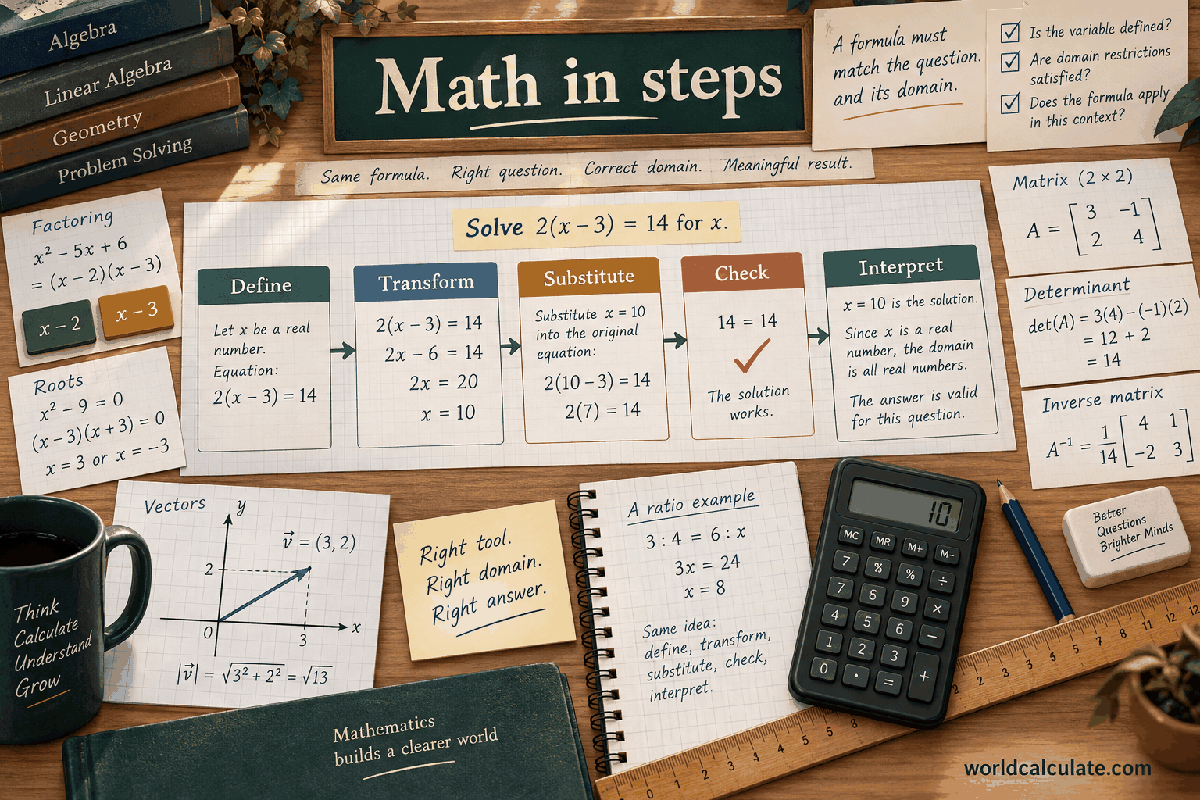
The standard equation of an axis-aligned ellipse records how far a point is from a chosen center in two perpendicular directions. This calculator accepts h and k for the center, a for the horizontal semiaxis, and b for the vertical semiaxis. It preserves those directional meanings even when the vertical semiaxis is longer, rather than silently renaming the axes by size. The result is a text equation plus finite numeric semiaxis information and squared denominators. It is distinct from ellipse area, foci, and circumference tools. This guide explains the translated form, signs, worked substitution, equal-axis edge case, validation, source boundary, assumptions, and conservative limits.
The output describes the boundary of an ideal ellipse centered at (h, k). A point (x, y) on that boundary makes the normalized squared horizontal displacement plus the normalized squared vertical displacement equal to one. The first denominator is a^2 and belongs to the horizontal x term. The second is b^2 and belongs to the vertical y term. This association is part of the contract and remains unchanged if a is smaller than b.
The calculator does not return the area enclosed by the ellipse, its circumference, its foci, or a rotated conic. Those are related questions with different outputs or assumptions. An axis-aligned equation is useful by itself for graphing, membership checks, and later analytic geometry, but it should not be read as a complete description of an observed oval when orientation, noise, or perspective has not been modeled.
Enter h and k as the center coordinates. Enter a as the positive distance from the center to the boundary along the horizontal axis, and b as the positive distance along the vertical axis. The labels intentionally say horizontal and vertical rather than only major and minor. That prevents a common ambiguity: standard ellipse notation often calls the larger semiaxis a, but this page's input contract is directional so it can represent a tall ellipse without changing the meaning of the fields.
All values are finite numbers inside the displayed software range. Center coordinates may be negative or zero. Both semiaxes must be strictly positive because a zero denominator would not describe an ordinary ellipse. The handler rejects strings, missing values, NaN, infinity, and out-of-range inputs before it squares a or b. Units are carried as generic length units; no automatic conversion is attempted.
For a centered ellipse, divide the horizontal coordinate by a and the vertical coordinate by b. The squared normalized coordinates measure the relative contribution of each direction. Their sum equals one on the boundary, is below one inside the ellipse, and is above one outside it. Translating the center replaces x with x-h and y with y-k. The standard relation is therefore (x-h)^2/a^2+(y-k)^2/b^2=1.
The calculator computes a^2 and b^2 as numeric values for the displayed equation. It does not expand the full polynomial because the standard form makes the axis roles easier to inspect. The equation builder shows y-k as y+|k| when k is negative. Numeric results retain the signed center inputs through the steps, so the readable plus sign is not a hidden change in the model.
Use h=2, k=-3, a=5, and b=2. Squaring the semiaxes gives 25 and 4. The equation is (x-2)^2/25+(y+3)^2/4=1. The rightmost point is (7,-3), because the horizontal displacement is +5 and the vertical displacement is zero. The top point is (2,-1), because the vertical displacement is +2. Both substitutions yield one: 25/25+0=1 and 0+4/4=1.
The center (2,-3) gives zero on both numerator terms, so the left side is zero and the point is inside the boundary. A point such as (7,-1) has normalized contributions 25/25 and 4/4, totaling two, so it lies outside. These checks distinguish the boundary equation from a filled-region test and show why each axis term needs its own semiaxis square.
Suppose a=2 and b=5. The result is still (x-h)^2/4+(y-k)^2/25=1. It represents a vertically elongated ellipse, but the field named a remains horizontal. Reordering the values before entry would describe a different shape in the same coordinate plane. This directional convention is useful when a later process expects x-radius and y-radius separately, even if an alternate textbook convention would rename the longer one as the major semiaxis.
If a=b, the standard equation becomes a circle equation centered at (h, k) with radius a. That special case is mathematically valid for this page, but the tool still reports an ellipse standard form and does not switch to an area or circumference result. The equality is a useful check of continuity: both denominators are the same and the x and y directions are treated symmetrically.
A negative h or k shifts the center without changing the shape. For example, k=-3 displays y+3 because y-(-3)=y+3. A zero center coordinate omits that translation in the text. The handler uses signed numeric values for calculations and a small formatting helper for the equation, so a visible sign cannot diverge from the coefficients used to compute a squared denominator.
The semiaxis lower bound is positive. A zero a or b would create division by zero and collapse the shape into a segment-like limit, so it is rejected rather than represented as an ellipse. The upper bound is a finite software safeguard. The handler checks a^2 and b^2 after input validation and checks every numeric returned value. Negative zero is normalized away before it reaches the shared renderer.
A direct check of the equation can classify a supplied test point if the surrounding task defines a tolerance. Compute the left side using the unrounded semiaxes and compare it with one. The calculator does not receive a test point or tolerance, so it does not decide boundary membership. Keeping that decision outside the handler avoids pretending that floating-point equality is a universal geometric rule.
The result can support a graphing exercise, an analytic-geometry derivation, or a bounded input to another reviewed calculation. It does not fit a rotated ellipse, estimate semiaxes from data, or convert a perspective image into Euclidean coordinates. If the source values came from measurements, preserve their precision and uncertainty. A long decimal equation is not evidence that the underlying shape was measured to the same precision.
The ellipse formula reference is retained in private catalog metadata for research and quality review. The public article, examples, and result wording are original WorldCalculate material. The source reference confirms the standard mathematical form but does not supply a visitor's coordinate frame, unit convention, orientation, or data quality. No external calculator page body, code, branding, defaults, or calculator data is used to define this record.
The model assumes an ideal axis-aligned ellipse in a flat Cartesian plane. It assumes positive finite semiaxes and a shared length unit, and it deliberately excludes rotation and uncertainty. A physical oval, orbital projection, image contour, or engineering boundary may require a richer model. Use this page as a transparent equation construction step, not as a fit certificate, manufacturing tolerance, or safety approval.
Is a the major axis? Not necessarily in this calculator. a is explicitly horizontal and b is explicitly vertical. If a>b, the horizontal direction is the major direction; if b>a, the vertical direction is longer. Does equal a and b make the page wrong? No. It produces the circle special case while preserving the requested standard-form contract. Why are a and b squared? The normalized distance contributions use squared ratios, so each semiaxis sets the scale of its coordinate direction.
Can the equation be used for a rotated ellipse? Not without changing the model. A rotated conic generally needs a cross term and an orientation parameter, neither of which is accepted here. Can it prove an area? The equation can be used as a starting point for a separate area formula, but the page itself does not calculate that area. The conservative limit is the four-field axis-aligned equation with finite positive semiaxes; do not infer unentered orientation, fit quality, or application safety.
The four axis endpoints follow directly from the directional fields. The horizontal endpoints are (h-a, k) and (h+a, k); the vertical endpoints are (h, k-b) and (h, k+b). Substituting any of them into the standard equation gives one because one normalized squared term is one and the other is zero. These endpoints provide an easy geometry check without expanding the equation or estimating a circumference.
The center is not on the boundary for positive semiaxes. At (h, k), both numerator terms vanish and the left side is zero, which places the center inside the ellipse. A point farther along an axis than its semiaxis produces a normalized contribution greater than one and lies outside. The calculator does not accept a test point, but the endpoint relationships explain how a caller can verify the returned equation with a separately chosen tolerance.
The horizontal extent of the ideal ellipse is from h-a to h+a, and the vertical extent is from k-b to k+b. These intervals are useful for a graph viewport or a simple bounding rectangle, but the handler does not return them as separate results. They are derived from the same center and semiaxis fields. Keeping a and b directional means the extents stay tied to their coordinate axes even when the vertical range is larger than the horizontal range.
The bounding rectangle contains points that are not on the ellipse. A corner such as (h+a, k+b) makes both normalized terms equal one and therefore lies outside the boundary with sum two. This distinction matters when a downstream visualization uses the extents to set a viewport. The equation remains the criterion for the ideal boundary; the rectangle is only a convenient display envelope and should not be mistaken for the ellipse itself.
The standard form keeps the center and two directional scales visible. Expanding it would create a quadratic relation with coefficients that include inverse squares of a and b and center-dependent linear terms. That expanded polynomial can be useful in another algebra task, but it is not the output contract here. The calculator therefore returns text in translated standard form and the squared denominators, which are easier to audit against the four entered fields.
A general quadratic may contain an xy term, unequal leading coefficients, or a different constant normalization. Such a polynomial cannot be assumed to be this axis-aligned ellipse without additional analysis. Conversely, the absence of an xy term here is a consequence of the chosen axes, not proof that every ellipse in a dataset is axis-aligned. The narrow standard-form result avoids silently applying a rotation or a coefficient fit that the visitor did not enter.
When a=b, the two directional scales are equal and the equation becomes ((x-h)^2+(y-k)^2)/a^2=1. Multiplying through gives the ordinary circle equation with radius a. This continuity is useful because the standard-form ellipse formula does not need a special circle branch. The output remains an ellipse equation by title, while the note acknowledges the circle special case rather than changing to an area or circumference result.
When one semiaxis is much larger than the other, the boundary becomes elongated in that direction, but it remains closed for every positive finite pair. There is no need to require a>=b because the input labels preserve horizontal and vertical meaning. A caller that wants semimajor and semiminor names must compare the values explicitly and may need a different focus convention. This page does not rename fields based on size.
The pure handler retains numeric h, k, a, and b values and computes squared semiaxes from those values. Equation text uses a bounded formatting helper so it stays readable, while the numeric results retain the calculation value. A displayed denominator such as 25 may be exact for an integer input, but a rounded decimal denominator should not be treated as the original measurement. The renderer's precision setting is a presentation choice, not a change to the equation.
If the semiaxes came from a measurement, record their uncertainty and significant digits separately. A long equation string can make a result look more precise than its source. The handler's finite checks prevent invalid arithmetic and renderer overflow, but they cannot recover lost precision or decide an acceptable tolerance for point membership. High-precision symbolic work or a fitted ellipse should use tools designed for those requirements.
A reviewer can first inspect the four field meanings: h and k are center coordinates, a is horizontal, and b is vertical. Next, square the two positive semiaxes and compare the displayed denominators. Then check the signs inside the translated parentheses, especially when h or k is negative. Finally, verify the four axis endpoints and confirm that the standard equation uses one on the boundary. This sequence tests both geometry and formatting without relying on an external parser.
The focused engine tests should also call the default example and the equal-axis case, then reject zero and nonfinite semiaxes. A vertical-longer case such as a=2, b=5 confirms that the handler does not reorder axes. The integrated catalog and renderer checks ensure that the exact record ID maps to the same handler in PHP and the browser. These checks protect the directional contract when future catalog waves add related ellipse tools.
When this equation is copied into a graphing or analytic workflow, carry h, k, a, and b alongside the formatted expression. A recipient can regenerate the four axis endpoints, confirm the horizontal and vertical extents, and distinguish an ideal standard form from an expanded polynomial. Copying only the visible denominator text may lose which value was entered as the horizontal or vertical semiaxis, especially when the two squares happen to be equal or close in size.
The result also benefits from a declared coordinate frame and length unit. The equation is invariant under translation only when the center is translated with the coordinates; it is not invariant under an unrecorded unequal rescaling of one axis. If the equation is used in a drawing, preserve the aspect ratio implied by a and b. A graphing viewport that uses unequal screen scales can make a mathematically correct ellipse look circular or distorted without changing the underlying relation.
A reliable workflow starts by naming the coordinate frame, center, horizontal semiaxis, and vertical semiaxis before constructing the equation. It then checks that the two semiaxes are positive, squares them, and verifies the translated signs. The returned standard form can be used as an input to graphing or point classification, but the receiving step should preserve the same unit and axis convention. This avoids a mathematically correct expression being transferred with its directions silently swapped.
The equation is an ideal model with finite software bounds. It does not say how the ellipse was measured or whether its boundary is physically exact. If a later process estimates area, circumference, foci, or a fit, record that it began from the standard-form record and apply the relevant formula and uncertainty. The calculator's value is its explicit four-field construction and its refusal to fill in unentered rotation or application context.
Construct the standard axis-aligned ellipse equation from a center and positive horizontal and vertical semiaxes.
(x-h)^2/a^2 + (y-k)^2/b^2 = 1, where a remains the horizontal semiaxis and b remains the vertical semiaxis. Translate the origin to the center, divide the squared horizontal displacement by a^2 and the squared vertical displacement by b^2, and set their sum to one. The axes are not reordered by length, so horizontal and vertical meaning is preserved.
Enter Center h, Center k, Horizontal semiaxis a, Vertical semiaxis b, then choose Calculate.
The ellipse is axis-aligned in a flat two-dimensional Cartesian coordinate system. a and b are positive semiaxes tied to horizontal and vertical directions respectively; a need not be greater than b. The equation is returned as a standard relation, not as an area, circumference, rotated-ellipse fit, or point-membership classification.
This calculator is part of the WorldCalculate library. Its formula, example, assumptions, input bounds, and output formatting follow the official methodology.
These WorldCalculate collections connect this tool with related questions while keeping each calculation separate and transparent.