
Goal
Stationary x-values where the derivative of a cubic is zero.
Worldwide context
Saved once here, used across the site.
Currency changes display only. Country selection guides tax input; no tax rate is guessed.
Stationary x-values where the derivative of a cubic is zero.
f' = 3a x^2 + 2b x + c; D = (2b)^2 - 12ac; x = (-2b +/- sqrt(D))/6a.A clearer path to an answer
This page keeps the calculation transparent: define the goal, enter the matching values, inspect the method, and decide what the result means in your situation.
Stationary x-values where the derivative of a cubic is zero.
a (x^3) · b (x^2) · c (x) · d (constant)
f' = 3a x^2 + 2b x + c; D = (2b)^2 - 12ac; x = (-2b +/- sqrt(D))/6a.
Calculate, review the assumptions below, then compare a related tool when the decision needs more context.
Stationary x-values where the derivative of a cubic is zero.
Open the Cubic Critical Points pageMore math tools
Download PDFDownload Word (.doc)
Enter your values above and choose Calculate to see the result here.
Calculation map
f' = 3a x^2 + 2b x + c; D = (2b)^2 - 12ac; x = (-2b +/- sqrt(D))/6a.
Bounded, transparent calculation
Your recent runs stay in this browser session only.
Formula: f' = 3a x^2 + 2b x + c; D = (2b)^2 - 12ac; x = (-2b +/- sqrt(D))/6a.
Differentiate term by term, then solve the quadratic derivative. A negative discriminant means monotone cubic with no real stationary point.
Worked example: Critical points x = 0 and x = 2.
The displayed limits are checked before the handler runs. Model-specific domain checks may also reject impossible or non-finite inputs.
Methodology: This calculator follows the WorldCalculate input, formula, precision, and boundary policy. Read the official methodology.
Calculator usage statistics
This section counts anonymous successful Calculate submissions, not unique visitors. Counts and top tools appear only when trusted aggregate data is available; country analysis is shown only under the same condition and reporting threshold.
Answer-first guide
Stationary x-values where the derivative of a cubic is zero. Start with one clearly defined goal, enter values in the units shown, and keep the result attached to the assumptions below.
This tool is useful when your question includes cubic critical points, derivative roots, stationary points. It returns the outputs declared in the calculator contract rather than a live quote, approval, diagnosis, or professional sign-off.
a (x^3) · b (x^2) · c (x) · d (constant). Keep the same time period, unit system, and currency wherever the form requires comparable values.
Run the worked example first, compare its output with the page's example, then change one input at a time. This makes an unexpected result easier to trace to a unit, boundary, or assumption.
Need a wider view? Browse Math Calculators or compare the related tools below. The WorldCalculate methodology explains how formulas, examples, limits, and revisions are reviewed.
f' = 3a x^2 + 2b x + c; D = (2b)^2 - 12ac; x = (-2b +/- sqrt(D))/6a.
Differentiate term by term, then solve the quadratic derivative. A negative discriminant means monotone cubic with no real stationary point.
Critical points x = 0 and x = 2.
Context and background
Math calculators move from named quantities to a relation, then to a result that can be checked with substitution, units, or an alternate form.
Arithmetic, algebra, geometry, trigonometry, and number theory provide reusable structures for classroom work and everyday reasoning. Each page narrows that structure to one declared problem.
Research and review
Researched by Hassan ALRowaie, Founder and editorial researcher at WorldCalculate.
This guide follows the live calculator's declared inputs, formula, worked example, assumptions, validation boundaries, and source-backed methodology. The review date describes editorial review of the calculator explanation; it is not a promise that external facts or rates remain current.
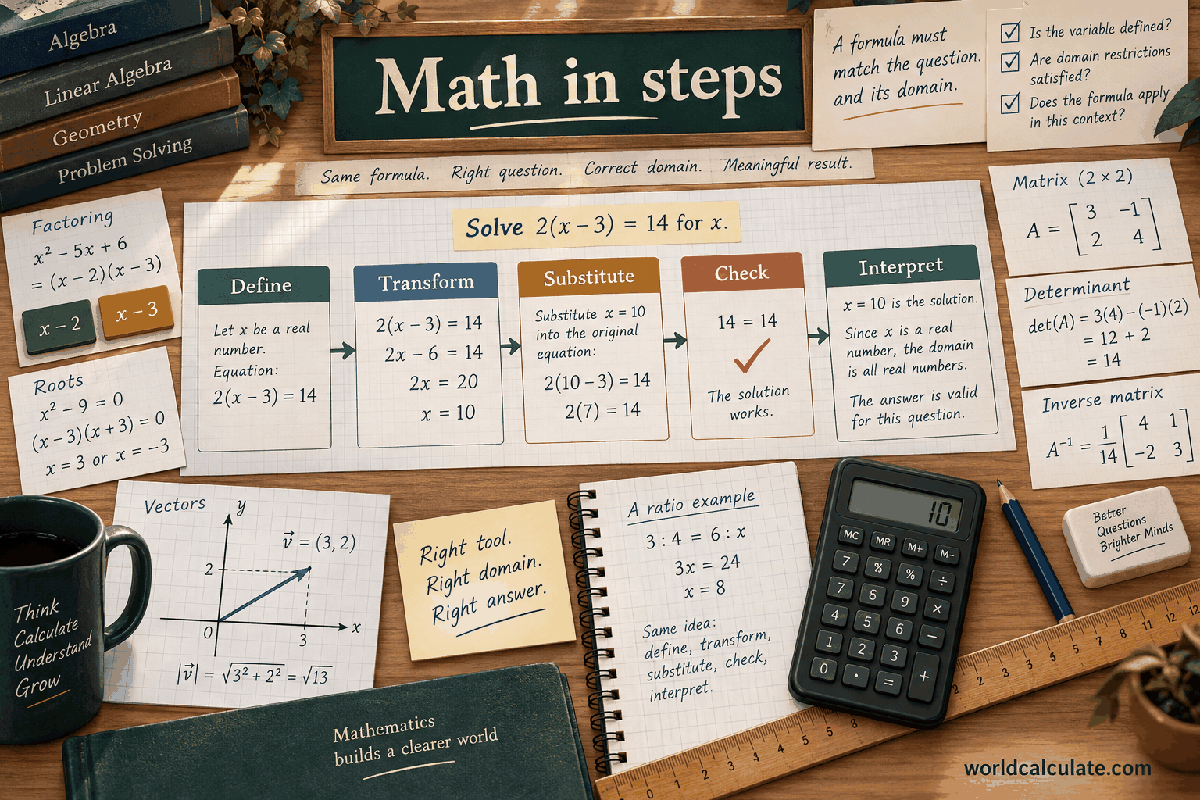
A cubic polynomial can change direction, flatten briefly, or pass through a horizontal tangent without becoming a quadratic. The critical points of f(x) = a x^3 + b x^2 + c x + d are the x-values where its derivative is zero. This calculator solves that derivative equation from four entered coefficients. It reports either two real stationary x-values, one repeated stationary x-value, or an explicit message that no real stationary x-value exists. The constant d is included because it belongs to the cubic a x^3 + b x^2 + c x + d, but it does not appear in the derivative and cannot move the critical points. The guide explains the derivative contract, the discriminant branches, the numerically stable quadratic solution, the default example, and the difference between finding a horizontal tangent and classifying the behavior of the original curve. The result is a bounded real-number exercise, not a graphing, optimization, or modeling claim.
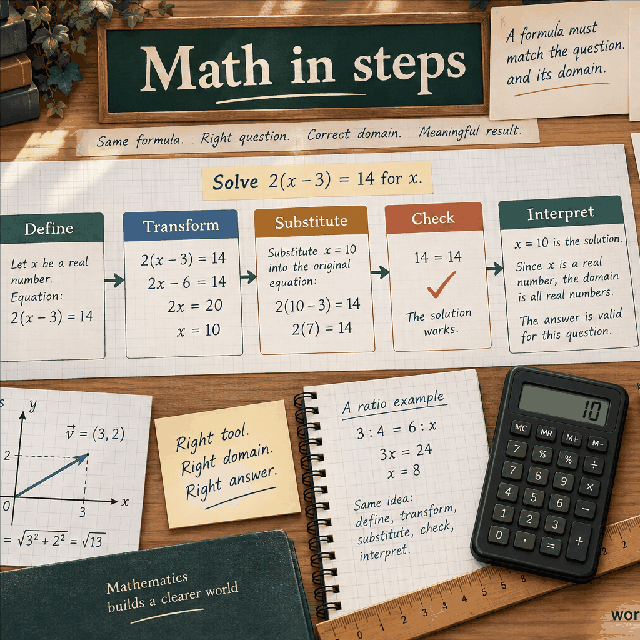
For a differentiable function, a critical point in this calculator means an x-value at which the first derivative is zero. The tangent line of the graph is horizontal there. A horizontal tangent is a local feature of the slope, not automatically a maximum or minimum. A curve may arrive at a flat point and continue in the same direction, or it may change from increasing to decreasing or the reverse. The page therefore returns stationary x-values and leaves the later interpretation explicit.
The word point can be misleading because this tool reports x-values rather than complete coordinate pairs. To obtain the corresponding y-value, substitute each returned x into the original cubic, including the constant d. That extra substitution is outside the handler because the requested output is the derivative's real roots. Keeping x-location and function height separate makes it clear what the calculator has established and what still requires another step.
Enter ca as the coefficient of x^3, cb as the coefficient of x^2, cc as the coefficient of x, and cd as the constant. The labels are intentionally tied to powers so that a sign or position is not lost when a polynomial is copied from a worksheet. The default values describe f(x) = x^3 - 3x^2 + 5. The constant is not a fourth derivative coefficient; it is part of the original function only.
Each field must arrive at the pure handler as a finite JavaScript number between -1,000,000,000 and 1,000,000,000. The browser form advertises the same broad range, while the handler repeats the check for direct calls. Numeric strings, missing values, NaN, positive infinity, negative infinity, and out-of-range values are rejected. A valid number still needs a meaningful interpretation in the surrounding mathematics; the generic bound is not a statement that every cubic in that range is useful.
The formula is specifically for a genuine cubic. If ca is zero, the x^3 term disappears and the original expression is no longer cubic. The derivative would then have a different degree and a different interpretation. A zero leading coefficient is therefore rejected rather than silently downgraded to a quadratic. This protects the page from returning an answer that appears to belong to the requested model while actually solving another one.
A very small nonzero ca is allowed if it is within the field bounds and the resulting arithmetic stays finite. Small coefficients can make the derivative roots sensitive to the other coefficients because the quadratic coefficient A = 3ca becomes small. That sensitivity is a property of the entered polynomial, not a reason for the handler to replace the value with zero. Record the coefficients and retain enough precision when a small leading term matters.
The power rule gives the derivative f-prime(x) = 3ca x^2 + 2cb x + cc. The derivative of ca x^3 is 3ca x^2, the derivative of cb x^2 is 2cb x, the derivative of cc x is cc, and the derivative of the constant cd is zero. The calculator constructs A = 3ca, B = 2cb, and C = cc, then solves A x^2 + B x + C = 0. These names describe the derivative equation rather than replacing the original coefficient fields.
The constant disappears because adding the same vertical amount at every x does not change the slope. If two cubics have identical ca, cb, and cc but different cd, their graphs are vertical translations. Their y-values differ, but their derivative graphs coincide, so they have the same stationary x-values. This is a useful structural check for both hand calculations and software output.
For A x^2 + B x + C = 0, the discriminant is D = B^2 - 4AC. The sign of D determines how many real derivative roots exist. A positive D gives two distinct real roots, a zero D gives one repeated real root, and a negative D gives no real roots. The calculator checks D before taking its square root, so a negative discriminant becomes a clear explanatory error rather than a NaN result.
Because A, B, and C are built from the cubic coefficients, the page's displayed discriminant is a property of f-prime. It is not the discriminant of the original cubic equation f(x) = 0. A user looking for x-intercepts needs a different cubic-root problem. Here the discriminant answers a narrower question: can the slope equation equal zero at real x-values?
A negative D means the quadratic derivative never reaches zero on the real axis. Since the leading derivative coefficient A is nonzero, the derivative keeps one sign throughout the real line. The original cubic is therefore strictly increasing or strictly decreasing under the ideal algebraic model, although the direction depends on the coefficient signs. The handler reports this condition with an error stating that there are no real critical points and does not manufacture complex roots.
No real critical point does not mean that the cubic has no roots, no inflection point, or no interesting behavior. A cubic can cross the x-axis while its slope remains positive, and every cubic has an inflection structure in the broad calculus sense. Those are different questions. The page only tests where the first derivative is zero, so use a root solver or a second-derivative analysis when another feature is needed.
When D is positive, the derivative parabola crosses the x-axis twice. The two crossing locations are the two stationary x-values of the original cubic. The handler calculates both and sorts them from smaller to larger before returning them as Critical point 1 (smaller) and Critical point 2 (larger). Sorting makes the output stable even when the quadratic formula's plus and minus branches would naturally arrive in the opposite order.
The locations alone do not state whether the first is a local maximum or the second is a local minimum. For a cubic with a positive leading coefficient and two distinct critical points, the usual shape often rises, falls, and rises, but the precise classification should be checked from f-double-prime or from the sign of f-prime on intervals. The calculator's note points to that next analysis without pretending to perform it.
When D equals zero, the derivative quadratic touches the x-axis at one repeated root. The calculator returns Critical point (double) and the discriminant value zero. This is one stationary x-value, but the derivative does not change sign through a simple crossing. For the original cubic, the horizontal tangent is commonly associated with a stationary inflection: the curve can flatten while continuing from one side to the other.
The repeated label refers to the algebraic multiplicity of the derivative root, not to two separate physical locations. Do not count it twice when reporting stationary x-values. As always, classification should use the second derivative and the surrounding sign pattern if the distinction affects the conclusion. The page keeps this branch separate so that one repeated answer is not mistaken for two nearly equal numerical answers.
The default inputs are ca = 1, cb = -3, cc = 0, and cd = 5. The original polynomial is f(x) = x^3 - 3x^2 + 5. Differentiating gives f-prime(x) = 3x^2 - 6x. In the solver notation, A = 3, B = -6, and C = 0. The discriminant is D = (-6)^2 - 4(3)(0) = 36, which is positive, so two real stationary x-values are expected.
The stable quadratic calculation gives x = 0 and x = 2 after sorting. Substitution into the derivative confirms f-prime(0) = 0 and f-prime(2) = 12 - 12 = 0. If full points are wanted, the original cubic gives f(0) = 5 and f(2) = 8 - 12 + 5 = 1, so the coordinates are (0, 5) and (2, 1). The page does not include those y-values because cd is not needed for the derivative roots.
Keep ca = 1, cb = -3, and cc = 0, but change cd from 5 to -100. The original curve moves down by 105 units, yet the derivative remains 3x^2 - 6x. The reported critical x-values remain 0 and 2. This is not a shortcut or an ignored input bug; it follows from the derivative of a constant being zero.
The constant still matters if the question changes from location to height. At x = 0, changing cd changes f(0) directly. At x = 2, it changes f(2) directly as well. If a report includes both a stationary location and a function value, retain the exact cd used for that report. A result that combines x-values from one constant with heights from another is internally inconsistent even though the derivative locations happen to match.
The familiar formula x = (-B plus or minus sqrt(D)) / (2A) is mathematically correct, but one branch can lose significant digits when -B and the square root have similar magnitudes. The handler uses q = -0.5 times (B plus a sign-aware square root), then obtains one root as q/A and the other as C/q. This arrangement reduces subtractive cancellation in many cases while preserving the same quadratic roots.
The output still uses ordinary finite JavaScript numbers. Stability is a safeguard, not an exact-arithmetic guarantee. Very large or badly scaled coefficients can make the last displayed digits sensitive to floating-point representation even when every input is within its declared range. The handler checks the discriminant and output values for finiteness, and the result formatter limits the display to six decimal places. Preserve raw inputs when more reproducibility is needed.
The derivative sign tells whether the cubic is increasing or decreasing on an interval. A simple derivative root can mark a sign change, while a repeated derivative root can leave the sign unchanged. The first and second derivatives work together: f-double-prime(x) = 6ca x + 2cb provides a quick local classification when evaluated at a distinct critical x. A positive second derivative indicates local concavity up, and a negative value indicates local concavity down, subject to the usual calculus interpretation.
This page deliberately does not add classification labels because doing so would require returning function values, evaluating a second derivative, and explaining edge cases such as a zero second derivative. Those are useful extensions but not part of the current result contract. If a decision depends on a local maximum, minimum, or inflection, use the returned x-values as inputs to a separately checked step and show that method in the surrounding work.
Validation occurs inside the handler before any result is returned. A non-number, nonfinite number, or value outside the inclusive coefficient range produces a clear error naming the relevant field. A zero ca produces a cubic-specific nonzero error. A negative discriminant produces the no-real-critical-points message. This fail-closed behavior is preferable to clipping a coefficient or returning an empty list that could be mistaken for a successful calculation.
The browser also applies numeric field bounds, but a direct JavaScript caller cannot rely on HTML attributes. The pure engine repeats type, finiteness, and range checks so tests and other interfaces receive the same contract. If an error appears after copying a value from a spreadsheet, inspect whether the transfer produced a string, an unsupported notation, or a value outside the page's generic safety bound. Correct the source rather than expecting the handler to guess.
A reproducible report should include the four coefficients, the derivative equation, the discriminant, and the returned branch. If two points are returned, state that they are ordered by x. If the repeated branch is returned, state its multiplicity. If no real points exist, preserve that result and explain that the derivative has no real zero rather than calling the calculation unsuccessful. These details let another reader recreate the branch decision without relying on a screenshot.
If the polynomial represents a measured or modeled quantity, add the units and describe what x means outside the calculator. The page knows only numbers; it cannot know whether x is time, distance, price, or an abstract variable. Do not turn a stationary point into an operational recommendation, an optimized setting, or a forecast without a model for the original quantity, domain restrictions, uncertainty, and consequences.
This calculator is useful for calculus practice, checking a derivative equation, locating possible turning behavior, and comparing how the first three coefficients shape a cubic's slope. It is also a compact test of discriminant branches and finite numeric handling. The result is strongest when the polynomial is explicitly written and the coefficient order is checked before calculation.
The page does not graph the function, solve the original cubic for x-intercepts, determine a global maximum or minimum on a restricted interval, propagate measurement uncertainty, or optimize a real system. A complete analysis may require domain constraints, endpoint comparisons, the second derivative, a graph, or an independent algebra system. Use the returned values as one transparent step in that larger analysis, and keep the model's assumptions visible.
The quickest arithmetic check is to substitute each returned x-value into 3ca x^2 + 2cb x + cc. A result close to zero supports the displayed critical location within the chosen tolerance. For the default polynomial, substituting 0 gives zero and substituting 2 gives 12 - 12 = 0. If the displayed value has been rounded to six places, use the underlying calculation or a tolerance rather than demanding that a rounded decimal reproduce an exact zero digit for digit.
A second check is to calculate the vertex of the derivative parabola. Its x-coordinate is -B/(2A), where A = 3ca and B = 2cb. When D = 0, that vertex lies on the horizontal axis and matches the repeated critical point. When D is positive, it lies between the two returned roots. This geometric relationship can catch a coefficient-order mistake even when a copied quadratic formula appears syntactically correct.
A third check is to compare the sign of the derivative on intervals separated by the roots. Choose a test value below the smaller root, between the roots, and above the larger root, then evaluate f-prime. A sign change through a simple root indicates a change in increase or decrease; no sign change through a repeated root supports the stationary-inflection interpretation. These checks add interpretation without changing what the calculator itself reports.
Stationary x-values where the derivative of a cubic is zero.
f' = 3a x^2 + 2b x + c; D = (2b)^2 - 12ac; x = (-2b +/- sqrt(D))/6a. Differentiate term by term, then solve the quadratic derivative. A negative discriminant means monotone cubic with no real stationary point.
Enter a (x^3), b (x^2), c (x), d (constant), then choose Calculate.
Genuine cubic: leading coefficient ca is nonzero. Real coefficients; critical points solve f-prime equals zero.
This calculator is part of the WorldCalculate library. Its formula, example, assumptions, input bounds, and output formatting follow the official methodology.
These WorldCalculate collections connect this tool with related questions while keeping each calculation separate and transparent.