
Goal
Add the two parallel bases and two legs of a nondegenerate convex trapezoid after checking that the four lengths can form the shape.
Worldwide context
Saved once here, used across the site.
Currency changes display only. Country selection guides tax input; no tax rate is guessed.
Add the two parallel bases and two legs of a nondegenerate convex trapezoid after checking that the four lengths can form the shape.
P = base1 + base2 + leg1 + leg2, for a nondegenerate convex trapezoid with base-difference and leg constraints satisfied.A clearer path to an answer
This page keeps the calculation transparent: define the goal, enter the matching values, inspect the method, and decide what the result means in your situation.
Add the two parallel bases and two legs of a nondegenerate convex trapezoid after checking that the four lengths can form the shape.
Parallel base 1 · Parallel base 2 · Leg 1 · Leg 2
P = base1 + base2 + leg1 + leg2, for a nondegenerate convex trapezoid with base-difference and leg constraints satisfied.
Calculate, review the assumptions below, then compare a related tool when the decision needs more context.
Add the two parallel bases and two legs of a nondegenerate convex trapezoid after checking that the four lengths can form the shape.
Open the Convex Trapezoid Perimeter pageMore math tools
Download PDFDownload Word (.doc)
Enter your values above and choose Calculate to see the result here.
Calculation map
P = base1 + base2 + leg1 + leg2, for a nondegenerate convex trapezoid with base-difference and leg constraints satisfied.
Bounded, transparent calculation
Your recent runs stay in this browser session only.
Formula: P = base1 + base2 + leg1 + leg2, for a nondegenerate convex trapezoid with base-difference and leg constraints satisfied.
A trapezoid perimeter is the sum of its four side lengths. The handler also checks the strict side relationship needed for two specified bases to be parallel in a nondegenerate convex configuration.
Worked example: The bases differ by 2, the legs satisfy the shape check, and P = 5 + 3 + 4 + 4 = 16 length units.
The displayed limits are checked before the handler runs. Model-specific domain checks may also reject impossible or non-finite inputs.
Methodology: This calculator follows the WorldCalculate input, formula, precision, and boundary policy. Read the official methodology.
Calculator usage statistics
This section counts anonymous successful Calculate submissions, not unique visitors. Counts and top tools appear only when trusted aggregate data is available; country analysis is shown only under the same condition and reporting threshold.
Answer-first guide
Add the two parallel bases and two legs of a nondegenerate convex trapezoid after checking that the four lengths can form the shape. Start with one clearly defined goal, enter values in the units shown, and keep the result attached to the assumptions below.
This tool is useful when your question includes trapezoid perimeter, quadrilateral perimeter, parallel bases. It returns the outputs declared in the calculator contract rather than a live quote, approval, diagnosis, or professional sign-off.
Parallel base 1 · Parallel base 2 · Leg 1 · Leg 2. Keep the same time period, unit system, and currency wherever the form requires comparable values.
Run the worked example first, compare its output with the page's example, then change one input at a time. This makes an unexpected result easier to trace to a unit, boundary, or assumption.
Need a wider view? Browse Math Calculators or compare the related tools below. The WorldCalculate methodology explains how formulas, examples, limits, and revisions are reviewed.
P = base1 + base2 + leg1 + leg2, for a nondegenerate convex trapezoid with base-difference and leg constraints satisfied.
A trapezoid perimeter is the sum of its four side lengths. The handler also checks the strict side relationship needed for two specified bases to be parallel in a nondegenerate convex configuration.
The bases differ by 2, the legs satisfy the shape check, and P = 5 + 3 + 4 + 4 = 16 length units.
Context and background
Math calculators move from named quantities to a relation, then to a result that can be checked with substitution, units, or an alternate form.
Arithmetic, algebra, geometry, trigonometry, and number theory provide reusable structures for classroom work and everyday reasoning. Each page narrows that structure to one declared problem.
Research and review
Researched by Hassan ALRowaie, Founder and editorial researcher at WorldCalculate.
This guide follows the live calculator's declared inputs, formula, worked example, assumptions, validation boundaries, and source-backed methodology. The review date describes editorial review of the calculator explanation; it is not a promise that external facts or rates remain current.
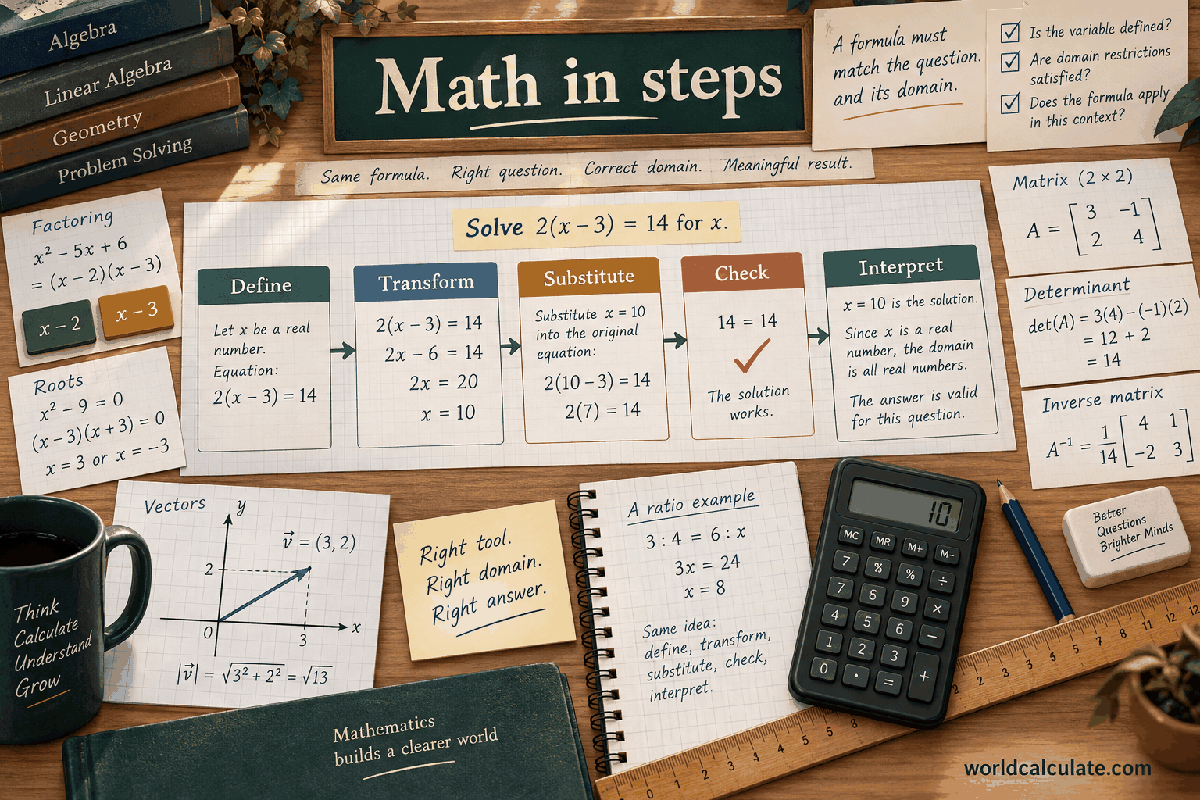
The perimeter of a trapezoid is the total length of its four boundary sides. This calculator accepts two lengths designated as parallel bases and two nonparallel leg lengths, checks the strict conditions for a nondegenerate convex configuration, and adds the four values. The output is one perimeter in the common length unit. The page does not calculate area, height, angles, diagonals, or a route around an arbitrary quadrilateral. The shape check is included because four positive numbers do not always support a trapezoid with the requested pair of parallel sides. The guide explains the side labels, feasibility inequality, isosceles and asymmetric cases, worked example, bounds, units, degeneracy, related quadrilaterals, and limits of using side arithmetic as a complete geometry model.
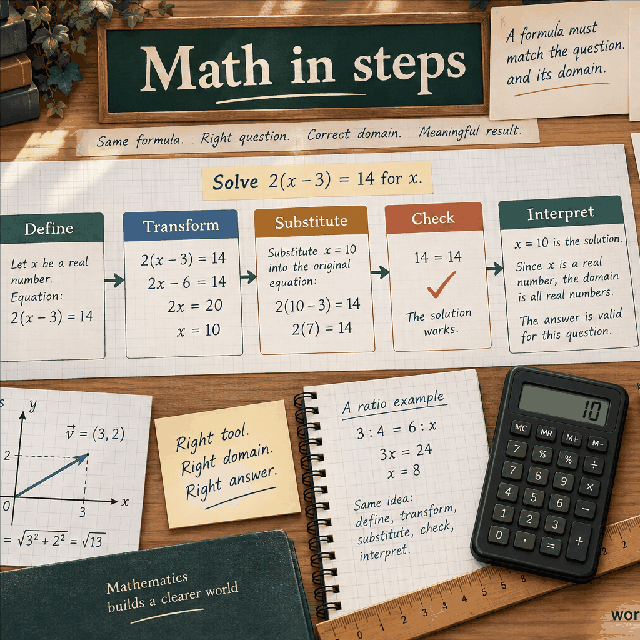
This page uses trapezoid in the common sense of a quadrilateral with one designated pair of parallel sides. Those sides are base1 and base2. The remaining sides are leg1 and leg2, and they connect the endpoints of the two bases. The result is the total boundary length P = base1 + base2 + leg1 + leg2. No angle or height is required to add the sides, but a shape check is useful because arbitrary positive lengths may describe an impossible or degenerate arrangement.
The handler chooses a nondegenerate convex model. That means the bases have positive lengths, the legs have positive lengths, the parallel sides do not collapse into one line, and the four values can be arranged with the designated bases parallel. A perimeter formula alone would return a sum even for an impossible set of sides. The page keeps the arithmetic simple while refusing those invalid geometric inputs, so the displayed number has the stated shape meaning.
Enter the length of one parallel side as base1 and the other as base2. The names do not imply that base1 must be longer; the handler uses their absolute difference for the shape test. Enter the two nonparallel sides as leg1 and leg2. The labels are side lengths, not angles, heights, horizontal projections, or diagonals. All four values must use the same length unit if the sum is to have a coherent interpretation.
Each field accepts a finite positive number from 0.000001 through 1,000,000 inclusive. Decimal sides are allowed. The bounds are software limits that keep direct calculations predictable and do not say that a physical trapezoid cannot be larger or smaller. The pure handler repeats the metadata checks and rejects missing values, numeric strings passed directly, NaN, infinities, zero, negative values, and values beyond the range instead of changing them into a different shape.
Let d = |base1 - base2| be the difference between the base lengths. If the bases are unequal, their horizontal mismatch must be resolved by the horizontal projections of the two legs. Those projections have magnitudes constrained by the leg lengths and a positive common height. A nondegenerate arrangement exists when the base difference is strictly less than leg1 + leg2 and strictly greater than |leg1 - leg2|. In compact form, |leg1 - leg2| < d < leg1 + leg2.
The first strict inequality prevents one leg from being too long relative to the other for the specified base difference, and the second prevents the two legs from being too short to span that difference. Equality produces a zero-height or collinear limiting arrangement. The handler applies this cross-field rule after checking individual bounds. This is more informative than merely applying a four-side polygon inequality because it addresses the chosen parallel-base structure specifically.
Use base1 = 5 length units, base2 = 3, and both legs equal to 4. The base difference is d = |5 - 3| = 2. The leg difference is zero, so 0 < 2, and the upper condition is 2 < 8. The shape check passes. The perimeter is simply 5 + 3 + 4 + 4 = 16 length units. Equal legs make this an isosceles trapezoid in the usual convex arrangement, although the perimeter calculation does not need to compute its height.
The same example also permits an independent height check. If the longer base is centered relative to the shorter one, each leg's horizontal projection is one unit. A right triangle then has hypotenuse 4 and horizontal leg 1, giving a positive height sqrt(15). That construction is not used by the handler, but it demonstrates why the side lengths can support a real nondegenerate shape. It also shows why adding the four values is valid after the domain check.
A trapezoid does not need equal legs. Suppose the bases differ by 5, while the legs are 4 and 3. The leg difference is 1 and the sum is 7, so 1 < 5 < 7. The legs can have different horizontal projections while sharing a positive height, producing an asymmetric convex trapezoid. Its perimeter remains the sum of the four entered sides. No symmetry assumption is needed for the boundary length or for the general feasibility inequality.
The position of the shorter base relative to the longer one can shift while preserving the four side lengths and parallelism, within the admissible projection interval. Such a shift can change angles and height relationships while leaving perimeter unchanged. That is why this page does not try to invent one placement or report a height from side lengths alone. When a later calculation needs area or angles, it should state the additional placement or use the relevant geometric inputs.
When base1 equals base2, d is zero. For a convex quadrilateral with those equal parallel sides, the remaining sides must have equal length, so the shape is a parallelogram branch with leg1 = leg2. The handler accepts this equal-base case only when the two legs are exactly equal. It rejects unequal legs with the message that equal parallel bases require equal legs for a nondegenerate convex trapezoid. This prevents a zero difference from passing the unequal-base inequality accidentally.
The perimeter of the accepted equal-base case is still 2 base1 + 2 leg1, but the page keeps the four fields to preserve the general trapezoid contract. Equal bases do not mean zero area or a collapsed shape; a parallelogram can have positive height. Conversely, an equality among lengths does not supply the height. Do not infer that the shape is a rectangle unless the legs are also perpendicular to the bases, which is not an input or a rule here.
A perimeter has the same dimension as each side. If all four fields are in centimetres, the result is in centimetres; if they are in metres, it is in metres. The calculator does not convert units or verify that an external measurement source used one scale. Mixing units can produce a finite sum with an invalid meaning. Establish the common unit before entry and keep it attached when sharing the result.
The individual bounds include both endpoints, and the relationship check adds the geometric domain. The engine checks the perimeter sum for finiteness even though the selected limits make overflow unlikely. Results are returned as a labeled number with same-length-units wording, text steps, and a note about convexity. The pure handler does not round the numeric sum. A display may show fewer digits, but later calculations should use the retained value and the stated unit.
If d equals leg1 + leg2, the two legs can only span the base mismatch in a collinear limiting arrangement, leaving no positive height. If d is larger, they cannot bridge the mismatch at all. If d equals or is smaller than the leg difference for unequal bases, one leg's required projection cannot be reconciled with the other while maintaining the same positive height. These values may still pass a generic sum-of-sides check, which is why the trapezoid-specific rule is necessary.
The handler also rejects equal bases with unequal legs. It does not attempt to repair a near-boundary value by rounding, because a tiny change can move a shape from valid to degenerate. Decimal inputs are compared as entered under ordinary JavaScript numeric semantics. If a measurement has uncertainty near a strict boundary, analyze that uncertainty outside this calculator and do not treat a passing rounded value as proof of physical nondegeneracy.
Perimeter is one-dimensional boundary length. Trapezoid area is one-half the sum of the bases times the height, so it needs height or enough additional side and placement information to derive it. The perimeter page does not report area because four side lengths and a pair of parallel labels do not always identify a unique height. A diagonal, interior angle, or midsegment is another separate quantity with its own formula and domain.
A route around a four-sided obstacle may also differ from the geometric perimeter if the obstacle has thickness, rounded corners, or restricted access. The result describes the ideal boundary represented by the four side lengths. Do not multiply it by a width to guess area or use it as a material cut length without allowance, joins, or tolerance rules. Keeping output dimensions visible helps prevent a correct perimeter from being reused as a different geometric measurement.
To reproduce a result, record the four side lengths, the common unit, and which pair is designated parallel. Compute d and the leg difference, verify the strict shape conditions, and then add the four sides. For a symmetric example, an independent right-triangle construction can check that a positive height exists. For an asymmetric example, confirm that the two projection intervals overlap. These checks explain the domain rather than treating the sum as valid for every positive input.
The calculator is useful for geometry exercises, outline estimates, and software tests of a parallel-base perimeter contract. It does not inspect a drawing, prove that a physical object is convex, or certify a fabricated part. For construction, surveying, or safety-sensitive work, validate measurements, angles, tolerances, and material details with domain tools. Preserve the shape assumption with the number and keep any later area, diagonal, or engineering conclusion as a separate reviewed calculation.
Suppose base1 is the longer base and let d be the positive base difference. Give leg1 a horizontal projection p. Its positive height h requires the projection to satisfy |p| < leg1. The other leg then has horizontal projection d - p and requires |d - p| < leg2. The two open intervals for p overlap exactly when the base difference is smaller than the leg sum and larger than the absolute leg difference. This is the geometric reason for the strict handler condition.
The projection explanation also shows why no height needs to be chosen for the perimeter. Many p values can satisfy the two inequalities, creating different heights and placements with the same four sides. The handler only needs to know that at least one positive-height convex arrangement exists. Once that domain fact is established, the boundary length is invariant under the allowed placement and is the direct sum of the four sides.
Four side lengths and a parallel pair determine the perimeter, but they do not always determine a unique trapezoid shape. Sliding the shorter base sideways can alter the two leg angles and the height while preserving side lengths within the feasible interval. An isosceles case has a familiar centered placement, but an asymmetric case can have several valid placements. The calculator intentionally reports the invariant boundary total rather than inventing a location for the top base.
This distinction is important when a perimeter is later used in an area or construction calculation. Area depends on height, and height can depend on the placement or on extra side and angle information. A perimeter result can be correct while an independently guessed area is wrong. Treat the output as complete only for the question of total boundary length under the stated side and shape assumptions.
Measured sides can sit close to the strict feasibility boundaries. Rounding each measurement before checking may make an impossible nominal set appear valid or make a valid set appear degenerate. Keep the recorded precision and uncertainty outside the simple perimeter value, and if a decision depends on nondegeneracy, analyze the full measurement interval. The handler uses the entered numeric values and does not claim tolerance clearance merely because the nominal inequalities pass.
A reproducible handoff includes base1, base2, leg1, leg2, their common unit, the designated parallel pair, and the result of the shape check. Recompute the four-side sum independently. If area, diagonal, cut length, or fit is needed, attach the additional geometry and allowances explicitly. The calculator's finite number is a useful arithmetic component, but it should not be promoted into a fabrication or structural certification without the missing evidence.
A practical review can begin without choosing coordinates for the four vertices. Sort the two bases only for the purpose of finding their difference, compute the leg sum and leg difference, and compare the strict inequalities. If they pass, a positive-height projection interval exists. If they fail, no amount of rearranging the same four values can create the requested convex parallel-base shape under this contract. This preflight is more useful than drawing one attempted arrangement and assuming its failure or success is universal.
After the shape check, add the sides in their original labels. Sorting the values for the inequality must not change which values are bases or legs in the final sum. A reviewer should be able to reconstruct both the domain decision and the perimeter from the input object. The engine keeps those operations separate, so an invalid shape is reported before a potentially misleading perimeter number is returned.
If a source contains a height, angle, or vertex list, use it to verify the side labels and parallel relationship, but do not add unused values to this page's contract. A quadrilateral can have four sides and still have no parallel pair, while a parallelogram has two parallel pairs and can be named through either pair. The calculator uses the pair designated by the field labels and does not discover parallelism from external geometry.
For a software integration, test a valid isosceles case, a valid asymmetric case, equal bases with equal legs, and each strict boundary failure. Use values near the boundaries without rounding them away. These tests cover the distinction between independent positivity checks, cross-field shape validity, and simple perimeter addition.
The output remains a length even when the shape check is the most interesting part of the calculation. Keep the validation note with the result so another system does not strip the domain assumption and reuse the sum as if it described an arbitrary four-sided outline.
A perimeter is invariant under rigid translation and rotation of a valid trapezoid, and it is also unchanged when the shorter base slides through another valid placement. This invariance explains why the handler needs no vertex coordinates. It does not mean that every four numbers with a positive sum form the same shape; the parallel-base and positive-height domain still controls whether the sum receives the trapezoid label.
If a downstream page needs the perimeter of an irregular quadrilateral, it may still add four sides, but it should use its own title and assumptions. Reusing this result without the parallel-base check would blur two different contracts. The visible validation note is therefore part of the mathematical meaning, not merely a user-interface warning.
The final unit check is simple: four lengths add to one length, not a squared area or a volume. If a conversion is required, apply the same linear factor to each side before adding, or convert the finished perimeter with that linear factor once. Keep the strict shape decision and the unit conversion visible in the record.
Add the two parallel bases and two legs of a nondegenerate convex trapezoid after checking that the four lengths can form the shape.
P = base1 + base2 + leg1 + leg2, for a nondegenerate convex trapezoid with base-difference and leg constraints satisfied. A trapezoid perimeter is the sum of its four side lengths. The handler also checks the strict side relationship needed for two specified bases to be parallel in a nondegenerate convex configuration.
Enter Parallel base 1, Parallel base 2, Leg 1, Leg 2, then choose Calculate.
Base1 and base2 are the one pair of parallel sides, and leg1 and leg2 are the nonparallel sides. The shape is nondegenerate and convex; for unequal bases, |base1-base2| lies strictly between |leg1-leg2| and leg1+leg2. All four lengths use compatible units and the perimeter is geometric boundary length, not area or an interior path.
This calculator is part of the WorldCalculate library. Its formula, example, assumptions, input bounds, and output formatting follow the official methodology.
These WorldCalculate collections connect this tool with related questions while keeping each calculation separate and transparent.