
Goal
Build the standard circle equation from a center and positive radius, then return the expanded quadratic coefficients.
Worldwide context
Saved once here, used across the site.
Currency changes display only. Country selection guides tax input; no tax rate is guessed.
Build the standard circle equation from a center and positive radius, then return the expanded quadratic coefficients.
(x-h)^2+(y-k)^2=r^2, or x^2+y^2+D*x+E*y+F=0 with D=-2h, E=-2k, F=h^2+k^2-r^2.A clearer path to an answer
This page keeps the calculation transparent: define the goal, enter the matching values, inspect the method, and decide what the result means in your situation.
Build the standard circle equation from a center and positive radius, then return the expanded quadratic coefficients.
Center h · Center k · Radius r
(x-h)^2+(y-k)^2=r^2, or x^2+y^2+D*x+E*y+F=0 with D=-2h, E=-2k, F=h^2+k^2-r^2.
Calculate, review the assumptions below, then compare a related tool when the decision needs more context.
Build the standard circle equation from a center and positive radius, then return the expanded quadratic coefficients.
Open the Circle Equation pageMore math tools
Download PDFDownload Word (.doc)
Enter your values above and choose Calculate to see the result here.
Calculation map
(x-h)^2+(y-k)^2=r^2, or x^2+y^2+D*x+E*y+F=0 with D=-2h, E=-2k, F=h^2+k^2-r^2.
Bounded, transparent calculation
Your recent runs stay in this browser session only.
Formula: (x-h)^2+(y-k)^2=r^2, or x^2+y^2+D*x+E*y+F=0 with D=-2h, E=-2k, F=h^2+k^2-r^2.
The center shifts the two coordinate axes and the positive radius sets the squared distance from the center. Expansion supplies the coefficients of x and y and the constant term in the implicit quadratic equation.
Worked example: (x-2)^2+(y+3)^2=25; expanded form is x^2+y^2-4x+6y-12=0, so D=-4, E=6, and F=-12.
The displayed limits are checked before the handler runs. Model-specific domain checks may also reject impossible or non-finite inputs.
Methodology: This calculator follows the WorldCalculate input, formula, precision, and boundary policy. Read the official methodology.
Calculator usage statistics
This section counts anonymous successful Calculate submissions, not unique visitors. Counts and top tools appear only when trusted aggregate data is available; country analysis is shown only under the same condition and reporting threshold.
Answer-first guide
Build the standard circle equation from a center and positive radius, then return the expanded quadratic coefficients. Start with one clearly defined goal, enter values in the units shown, and keep the result attached to the assumptions below.
This tool is useful when your question includes circle equation, standard circle form, center radius. It returns the outputs declared in the calculator contract rather than a live quote, approval, diagnosis, or professional sign-off.
Center h · Center k · Radius r. Keep the same time period, unit system, and currency wherever the form requires comparable values.
Run the worked example first, compare its output with the page's example, then change one input at a time. This makes an unexpected result easier to trace to a unit, boundary, or assumption.
Need a wider view? Browse Math Calculators or compare the related tools below. The WorldCalculate methodology explains how formulas, examples, limits, and revisions are reviewed.
(x-h)^2+(y-k)^2=r^2, or x^2+y^2+D*x+E*y+F=0 with D=-2h, E=-2k, F=h^2+k^2-r^2.
The center shifts the two coordinate axes and the positive radius sets the squared distance from the center. Expansion supplies the coefficients of x and y and the constant term in the implicit quadratic equation.
(x-2)^2+(y+3)^2=25; expanded form is x^2+y^2-4x+6y-12=0, so D=-4, E=6, and F=-12.
Context and background
Math calculators move from named quantities to a relation, then to a result that can be checked with substitution, units, or an alternate form.
Arithmetic, algebra, geometry, trigonometry, and number theory provide reusable structures for classroom work and everyday reasoning. Each page narrows that structure to one declared problem.
Research and review
Researched by Hassan ALRowaie, Founder and editorial researcher at WorldCalculate.
This guide follows the live calculator's declared inputs, formula, worked example, assumptions, validation boundaries, and source-backed methodology. The review date describes editorial review of the calculator explanation; it is not a promise that external facts or rates remain current.
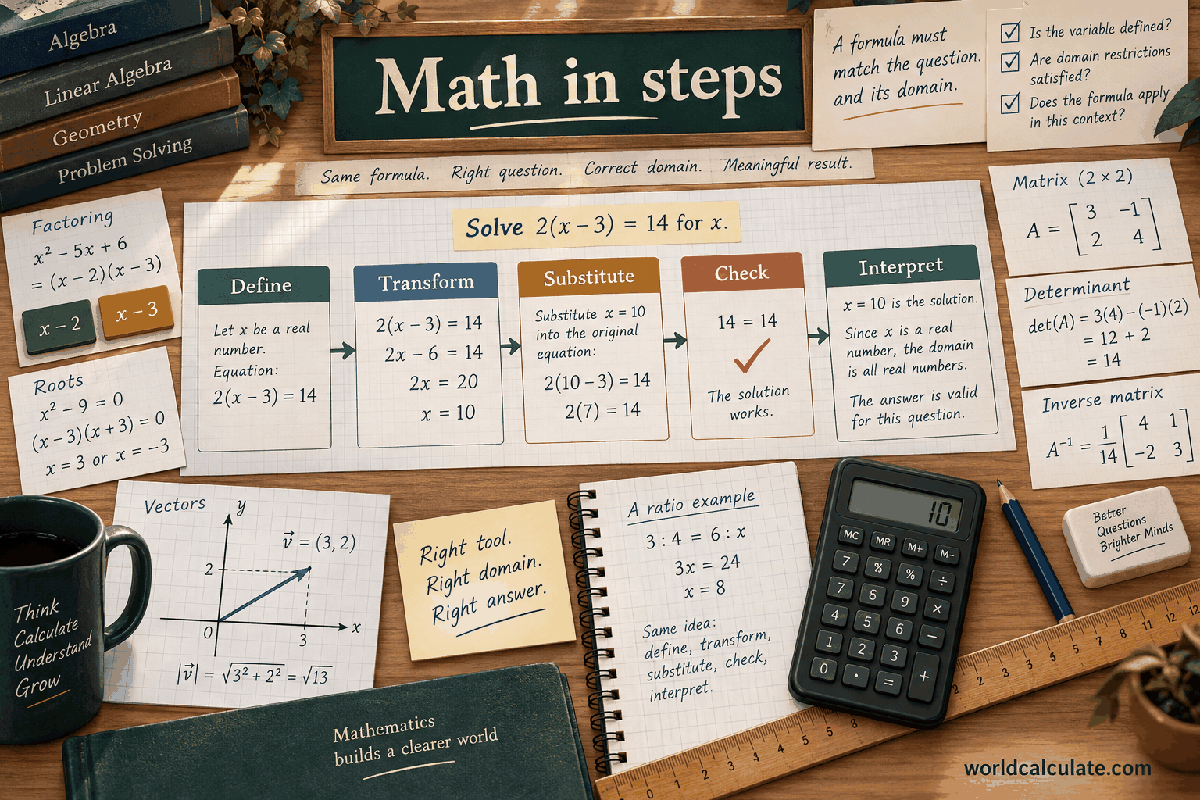
A circle equation describes the set of plane points at one fixed positive distance from a center. This calculator starts with center coordinates h and k and radius r, returns the translated standard form, and also supplies the expanded coefficients in x^2+y^2+D*x+E*y+F=0. The equation-building task is intentionally separate from calculating circle area or circumference: the output is an implicit relation, not a measure of the disk or its boundary. The guide explains translation signs, expansion, worked substitutions, finite validation, degenerate boundaries, related tools, source metadata, assumptions, and conservative limits so a familiar formula is not overextended into a broader geometry claim.
The main output is a relation that can be tested by inserting any point (x, y). Points on the circle satisfy the relation exactly in the mathematical model; points inside or outside produce different squared distances from the center. The calculator returns the standard equation first because center-radius form keeps the geometry visible. It then returns the radius squared and the three expanded coefficients D, E, and F so another bounded calculation can use the implicit representation without repeating the algebra.
This contract is distinct from a circle area or circumference calculator. Area concerns the filled disk and circumference concerns the boundary length. An equation instead describes membership in a locus. A positive radius is required even though a radius of zero could describe one point in a limiting sense. Rejecting that degenerate case preserves the ordinary circle interpretation and makes the output assumptions match the title.
The h field is the center's x-coordinate and k is its y-coordinate. A positive h moves the center right and a negative h moves it left; the same sign interpretation applies to k vertically. Radius r is a length and must be greater than zero. All three fields are finite numbers within the displayed software bounds. The form has no unit conversion selector, so coordinates and radius should be expressed in one compatible length convention before entry.
Direct calls use the same strict type and range checks as form submissions. Numeric strings, blanks, NaN, infinity, and values outside the declared bounds are rejected. The radius lower bound is a small positive software boundary rather than a universal geometric minimum. Center coordinates may be zero or negative. A zero center is ordinary; it means the circle is centered at the origin and simplifies the translated terms without changing the formula.
The Euclidean distance from a point (x, y) to the center (h, k) is sqrt((x-h)^2+(y-k)^2). Setting that distance equal to r and squaring both sides gives (x-h)^2+(y-k)^2=r^2. Squaring is safe here because both sides of the original distance equation are nonnegative. This form exposes the horizontal and vertical translation directly. The calculator computes r^2 as a finite numeric result and inserts it into the equation text.
The parentheses matter. If k is negative, y-k becomes y+|k|, not y-|k|. The helper that builds the equation chooses the visible sign from the entered center while the numeric coefficient calculation uses the original signed value. Keeping those two layers aligned prevents a readable equation from disagreeing with D and E. The equation text is a renderer-safe string; it is not subsequently parsed or evaluated by the engine.
Expanding gives x^2-2h*x+h^2+y^2-2k*y+k^2=r^2. Move the right side to the left to obtain x^2+y^2-2h*x-2k*y+(h^2+k^2-r^2)=0. The requested coefficients are D=-2h, E=-2k, and F=h^2+k^2-r^2. The quadratic coefficients of x^2 and y^2 are both one, and there is no xy term. That pattern is the algebraic signature of an axis-aligned circle in ordinary Cartesian coordinates.
The signs of D and E are tied directly to the center. A center at h=2 produces D=-4, while k=-3 produces E=6. F combines the squared center distance with the negative radius squared, so it can be positive, zero, or negative. These coefficients are not independent free inputs in this calculator; they are derived from the center-radius fields. That prevents an inconsistent general quadratic from being mislabeled as a circle.
Use h=2, k=-3, and r=5. The translated form is (x-2)^2+(y+3)^2=25. The radius squared is 25. Expanding gives D=-4, E=6, and F=2^2+(-3)^2-25=4+9-25=-12, so the general form is x^2+y^2-4x+6y-12=0. The center and radius remain visible in the first equation, while the coefficient results make the same locus available to an implicit-equation consumer.
Check the center point (2,-3): the left side of the standard form is zero, so the center is inside rather than on the circle. Check (2,2), which is five units vertically from the center: (2-2)^2+(2+3)^2=25, so it lies on the boundary. Check (2,3), six units away: its squared distance is 36 and it lies outside. These substitutions clarify that the equation describes a boundary, not a filled region.
The standard form always uses x-h and y-k. When h is positive, the visible x term is x minus that positive value. When h is negative, the visible term becomes x plus its magnitude. The same rule applies independently to k. For h=-4 and k=6, the equation contains (x+4)^2+(y-6)^2. Reading the sign inside the parentheses as the opposite of the center coordinate is a reliable way to avoid an expansion error.
The numeric coefficients use the signed center directly: D=-2h and E=-2k. Thus h=-4 gives D=8, and k=6 gives E=-12. The helper that formats the equation and the arithmetic that derives coefficients must agree on that sign relationship. A visually plausible equation with a mismatched D or E would describe a different center, which is why the focused tests should inspect both text and numeric coefficient results.
Radius r is the fixed distance from the center to every point on the circle. The equation uses r^2, so changing r changes the right side and F while leaving D and E unchanged. A larger radius produces a larger boundary around the same center. A smaller positive radius produces a smaller boundary. The calculator returns r^2 as a numeric result because it is central to the standard equation, but it does not infer area, circumference, diameter, or a unit conversion.
The radius field is bounded below by a small positive value and above by the shared positive limit. A radius of zero would collapse the locus to one point. Although such a set can be studied algebraically, this record is intentionally about an ordinary circle with a positive size. Negative radius values do not add a new circle because distance is nonnegative; they are rejected rather than converted to their absolute value so the input contract stays explicit.
For a candidate point (u, v), evaluate (u-h)^2+(v-k)^2. Equality with r^2 means the point is on the circle. A value less than r^2 means the point is inside the disk, and a value greater than r^2 means it is outside. This classification is an interpretation step; the handler itself constructs the equation and does not accept a third point for membership testing. Keeping the tasks separate prevents a circle equation page from silently becoming a point-in-region tool.
The expanded form gives the same classification after evaluating u^2+v^2+D*u+E*v+F, which should equal the standard expression minus r^2. Because decimal arithmetic is finite precision, a caller comparing a result to zero should use a tolerance appropriate to its scale. The calculator does not promise exact symbolic equality for arbitrary decimal substitutions. Its finite checks guarantee safe numeric construction, not unlimited precision.
A circle equation is not the same as a circle area calculator. Area is pi*r^2 and describes the filled disk, while the equation describes the points at exactly radius r. It is also distinct from circumference, which measures boundary length. The catalog keeps these questions separate so the title, fields, formula, and output all agree. A visitor who needs more than the equation should choose a separate calculator rather than reinterpret the coefficient fields.
This page also excludes rotated conics and general quadratic fitting. A quadratic with unequal x^2 and y^2 coefficients, an xy term, or noisy point data may describe an ellipse, a rotated conic, or a fitted model. The present inputs guarantee a center-radius circle in an axis-aligned Cartesian plane. The formula is reusable, but the narrow contract is a feature: it prevents a familiar equation from being treated as a universal curve classifier.
The pure handler requires h, k, and r to be JavaScript numbers that are finite and within the displayed bounds. It checks r^2, D, E, and F before constructing result entries. A direct call with a numeric string, blank, NaN, infinity, or an out-of-range value throws instead of relying on browser form coercion. The same validation makes the module usable in focused tests and in the browser registry without a hidden second implementation of the domain rules.
The equation is returned as text and the derived measures are returned as finite numeric results with labels and units. No expression is parsed after it is formatted, so symbols such as h and k remain explanatory text. Negative zero is normalized in numeric output. The renderer can show the standard equation, radius squared, and coefficients without deciding whether the user intended an area, a circumference, or an intersection operation.
If h, k, and r are in metres, the center coordinates and radius are in metres and the squared radius and F have square-length implications in the equation. If the values are abstract graph units, the outputs retain that abstraction. The calculator has no unit selector and cannot know whether a coordinate was measured, converted, or copied from a drawing. Use one origin, axis orientation, scale, and unit convention for the center and radius before calculation.
The plus or minus 1,000,000 coordinate bound and positive radius bound are conservative software limits. They keep intermediate squares and formatted outputs finite for ordinary browser use, but they do not define the largest possible circle in mathematics. Very large or highly precise physical inputs may need a numerical library, uncertainty analysis, or unit scaling outside this handler. Display precision is not a measurement guarantee and should not be used as one.
The catalog source is private formula provenance for the standard center-radius and expanded circle forms. This public article is original WorldCalculate writing and does not reproduce another site's body, code, branding, defaults, or calculator data. Formula provenance confirms the algebraic relationship, but it cannot confirm that a visitor's center and radius came from a valid survey, drawing, sensor, or design specification. That provenance and review belong to the surrounding workflow.
The model assumes a flat Euclidean plane, finite exact-enough inputs, a positive radius, and an axis-aligned standard form. It excludes uncertainty bands, fitted circles, perspective correction, geographic projection, rotated conics, and physical tolerance decisions. A circle equation can be a useful idealization while a real object has thickness or deformation. Use the result as a transparent equation construction, then apply domain-specific validation before relying on it.
Why does a negative center make a plus sign? The form is x-h, so a negative h becomes x+|h|; the expanded coefficient still follows D=-2h. Why is radius required to be positive? This page models an ordinary nondegenerate circle rather than a single point. Does F identify the radius? Not by itself: F also contains h^2+k^2, so center and radius fields are needed to interpret it. Why is there no xy term? The contract is an unrotated circle in standard Cartesian axes.
Can I use the equation to compute area? You can use the same radius in a separate area formula, but this handler intentionally returns equation outputs only. Can I enter a general quadratic? No. The fields describe center and positive radius, not free polynomial coefficients. What if an observed shape is almost circular? The calculator can provide an ideal reference circle, but fitting and residual analysis should be done by a method that accepts observations and uncertainty.
Changing the center translates the circle without changing its radius or shape. If h and k are both increased by known offsets, every point on the circle moves by those offsets, while r^2 remains unchanged. Changing the radius scales the boundary around the same center. These simple transformations help review a result: D and E should respond to center changes, F should respond to center and radius changes, and the standard equation should retain the same parenthesis structure.
A rotation of a circle about its center does not change the geometric circle, which is why no orientation field is needed. A coordinate transformation with unequal scale, however, can turn a circle into an ellipse in the new coordinates. The calculator assumes the entered frame is already the intended Euclidean frame. It does not infer whether a drawing was stretched, projected, or converted from another system.
For h=2, k=-3, and r=5, verify the expanded expression at the boundary point (2,2). The standard left side is (2-2)^2+(2+3)^2=25. In the expanded form, 2^2+2^2-4(2)+6(2)-12 equals 4+4-8+12-12=0. The two forms therefore agree at that point. Repeating the substitution at (7,-3) gives the same boundary result and tests the horizontal translation separately.
For a point such as (2,3), the standard left side is 36, which is greater than 25 and confirms it is outside. For the center (2,-3), the left side is zero and confirms it is inside. These tests are not returned by the handler because no test-point fields exist. They are useful review procedures and explain why an equation result should not be confused with a single boolean membership answer.
A downstream graph, solver, or document should retain whether the equation is the standard center-radius form or its expanded coefficient form. The two strings describe the same ideal boundary when D, E, and F were derived from h, k, and r, but the standard form makes the geometry easier to audit. Include the positive-radius assumption, the coordinate unit, and the fact that the equation represents a boundary rather than the filled disk.
If a later calculation needs a point test, area, circumference, intersection, or fitted curve, add that operation explicitly. Do not infer it from the presence of D, E, and F. The pure handler is intentionally small and deterministic: it constructs one circle relation, returns finite derived coefficients, and leaves application-specific questions to their own contracts. This separation helps prevent a correct equation from being used as an unexplained physical or statistical conclusion.
Build the standard circle equation from a center and positive radius, then return the expanded quadratic coefficients.
(x-h)^2+(y-k)^2=r^2, or x^2+y^2+D*x+E*y+F=0 with D=-2h, E=-2k, F=h^2+k^2-r^2. The center shifts the two coordinate axes and the positive radius sets the squared distance from the center. Expansion supplies the coefficients of x and y and the constant term in the implicit quadratic equation.
Enter Center h, Center k, Radius r, then choose Calculate.
The circle lies in a flat two-dimensional Cartesian plane with one shared coordinate unit. The center coordinates are finite and the radius is strictly positive; no degenerate point-circle is accepted. The returned coefficients describe the equation only and do not calculate area, circumference, intersections, or a fitted circle.
This calculator is part of the WorldCalculate library. Its formula, example, assumptions, input bounds, and output formatting follow the official methodology.
These WorldCalculate collections connect this tool with related questions while keeping each calculation separate and transparent.