
Goal
Convert a tax-exempt yield into the taxable yield that would leave the same after-tax return at an entered tax rate.
Worldwide context
Saved once here, used across the site.
Currency changes display only. Country selection guides tax input; no tax rate is guessed.
Convert a tax-exempt yield into the taxable yield that would leave the same after-tax return at an entered tax rate.
Taxable-equivalent yield = tax-exempt yield ÷ (1 − tax rate); after-tax check = taxable-equivalent yield × (1 − tax rate).A clearer path to an answer
This page keeps the calculation transparent: define the goal, enter the matching values, inspect the method, and decide what the result means in your situation.
Convert a tax-exempt yield into the taxable yield that would leave the same after-tax return at an entered tax rate.
Tax-exempt yield · Tax rate assumption
Taxable-equivalent yield = tax-exempt yield ÷ (1 − tax rate); after-tax check = taxable-equivalent yield × (1 − tax rate).
Calculate, review the assumptions below, then compare a related tool when the decision needs more context.
Convert a tax-exempt yield into the taxable yield that would leave the same after-tax return at an entered tax rate.
Open the Taxable-Equivalent Yield Calculator pageMore finance tools
Download PDFDownload Word (.doc)
Enter your values above and choose Calculate to see the result here.
Calculation map
Taxable-equivalent yield = tax-exempt yield ÷ (1 − tax rate); after-tax check = taxable-equivalent yield × (1 − tax rate).
Bounded, transparent calculation
Your recent runs stay in this browser session only.
Formula: Taxable-equivalent yield = tax-exempt yield ÷ (1 − tax rate); after-tax check = taxable-equivalent yield × (1 − tax rate).
The calculator answers a narrow comparison question: what pre-tax yield would leave the same after-tax percentage if the entered tax rate applied uniformly? It does not decide whether a product is tax-exempt or whether two investments have equal risk, duration, liquidity, fees, or legal treatment.
Worked example: Taxable-equivalent yield = 4%; tax at 25% = 1 percentage point; after-tax check = 3%.
The displayed limits are checked before the handler runs. Model-specific domain checks may also reject impossible or non-finite inputs.
Methodology: This calculator follows the WorldCalculate input, formula, precision, and boundary policy. Read the official methodology.
Calculator usage statistics
This section counts anonymous successful Calculate submissions, not unique visitors. Counts and top tools appear only when trusted aggregate data is available; country analysis is shown only under the same condition and reporting threshold.
Answer-first guide
Convert a tax-exempt yield into the taxable yield that would leave the same after-tax return at an entered tax rate. Start with one clearly defined goal, enter values in the units shown, and keep the result attached to the assumptions below.
This tool is useful when your question includes tax equivalent yield calculator, tax-exempt yield, taxable equivalent yield. It returns the outputs declared in the calculator contract rather than a live quote, approval, diagnosis, or professional sign-off.
Tax-exempt yield · Tax rate assumption. Keep the same time period, unit system, and currency wherever the form requires comparable values.
Run the worked example first, compare its output with the page's example, then change one input at a time. This makes an unexpected result easier to trace to a unit, boundary, or assumption.
Need a wider view? Browse Finance Calculators or compare the related tools below. The WorldCalculate methodology explains how formulas, examples, limits, and revisions are reviewed.
Taxable-equivalent yield = tax-exempt yield ÷ (1 − tax rate); after-tax check = taxable-equivalent yield × (1 − tax rate).
The calculator answers a narrow comparison question: what pre-tax yield would leave the same after-tax percentage if the entered tax rate applied uniformly? It does not decide whether a product is tax-exempt or whether two investments have equal risk, duration, liquidity, fees, or legal treatment.
Taxable-equivalent yield = 4%; tax at 25% = 1 percentage point; after-tax check = 3%.
Context and background
Finance tools compare amounts across time, rates, and definitions. A payment, balance, return, or ratio is meaningful only when its period, cash-flow timing, and units are stated.
Financial planning developed around making cash flows and performance comparable. WorldCalculate keeps that practical tradition visible through explicit formulas and scenario inputs rather than assuming a universal contract.
Research and review
Researched by Hassan ALRowaie, Founder and editorial researcher at WorldCalculate.
This guide follows the live calculator's declared inputs, formula, worked example, assumptions, validation boundaries, and source-backed methodology. The review date describes editorial review of the calculator explanation; it is not a promise that external facts or rates remain current.
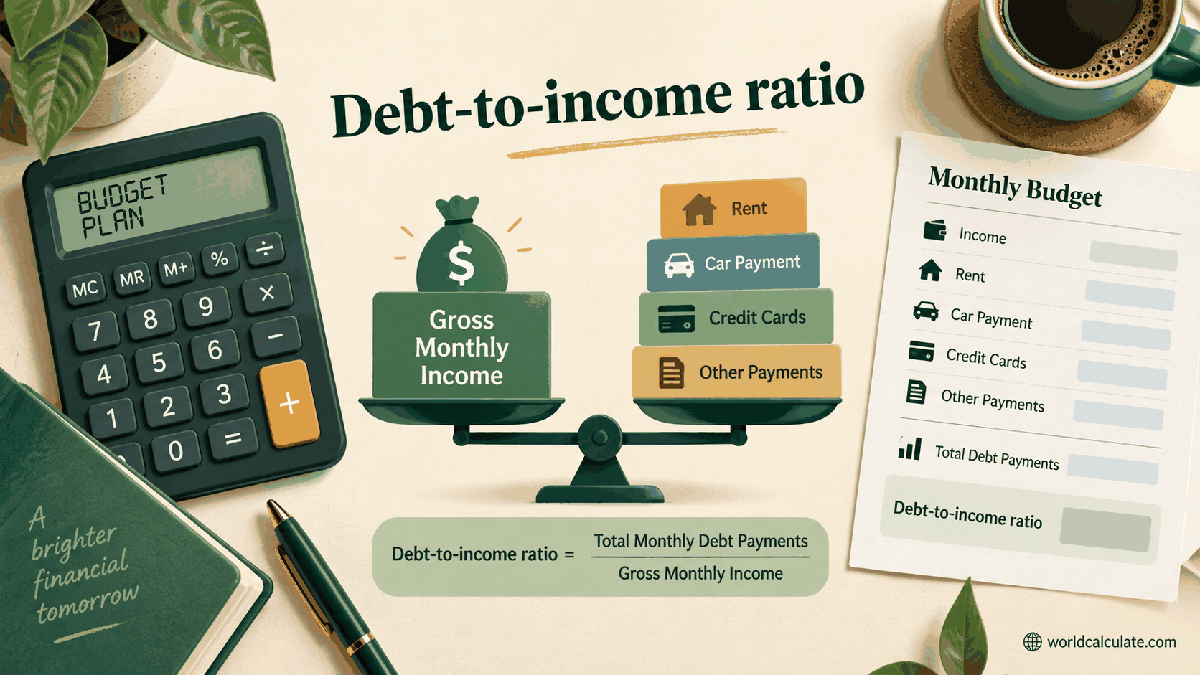
A tax-exempt yield can look lower than a taxable yield while leaving the same percentage after tax. The taxable-equivalent yield is a simple gross-up that makes that comparison visible under one entered tax assumption. Because tax treatment is personal and jurisdiction-specific, the calculator keeps the formula narrow and does not label any investment as exempt.
Suppose one yield is treated as exempt from the tax represented by the entered rate. The question is: what taxable yield would leave the same after-tax percentage? If the tax-exempt yield is E and the tax rate is t, the taxable equivalent is E ÷ (1 − t). The page then subtracts the modeled tax from that equivalent to show the equality check.
At a 3% tax-exempt yield and a 25% tax assumption, the equivalent is 3% ÷ 0.75 = 4%. Tax at 25% is 1 percentage point, leaving 3% after tax. The result is a comparison, not a prediction of a bond’s future return.
The taxable yield is the amount before tax, so the after-tax relationship is taxable yield × (1 − tax rate) = tax-exempt yield. Solving for taxable yield requires division by the retained fraction. Subtracting 25% from 3% would answer a different question and would understate the equivalent taxable yield.
As the tax rate rises, the retained fraction becomes smaller and the grossed-up taxable equivalent becomes larger. The calculator shows the uplift in percentage points so the visitor can see how much of the comparison comes from the assumption rather than from the investment itself.
A coupon rate, current yield, yield to maturity, distribution yield, and total return are not interchangeable. The formula can be applied to any entered yield only if both alternatives use the same definition, period, price basis, and compounding convention.
Before comparing two securities, write down whether the input is a quoted yield, a realized return, or a projected return. Fees, premium or discount, call features, default risk, duration, liquidity, and price volatility may matter more than a small tax-equivalent difference.
The label ‘tax-exempt’ can refer to a particular tax, investor, jurisdiction, account, income category, or holding condition. A security may be exempt from one tax but not another, and a resident may face a different rule from a nonresident. The calculator intentionally asks the visitor to supply the tax assumption rather than making that legal determination.
For a worldwide comparison, record the country or region, tax year, investor status, tax type, and source of the exemption. A currency selector can format a separate investment amount, but it does not establish the applicable tax rate or convert a yield into a local legal result.
A negative entered yield is retained as a mathematical scenario, although it may represent a fee-like or price-based outcome rather than ordinary coupon income. The tax rate must remain below 100% because a 100% rate would make the gross-up denominator zero.
High rates produce large equivalent yields and should prompt a review of the input. A high result does not mean the tax-exempt investment is automatically better; it only says the taxable comparison would need that yield under the selected uniform-rate assumption.
The best use is to place the output next to an actual after-tax estimate that includes the relevant tax treatment, costs, and cash-flow definition. If the alternative taxable yield is above the taxable-equivalent result, it may produce a higher after-tax percentage under the simplified model; if it is below, the opposite is true. Risk and liquidity remain separate decisions.
Do not compare a tax-exempt yield to a taxable total return without adjusting the definitions. A total return can include price change and reinvestment, while a current yield may not. Keep the same horizon and terminology on both sides of the comparison.
A clear worksheet note states: tax-exempt yield, assumed tax rate, formula, resulting equivalent yield, and which taxes are or are not included. For the default, record 3%, 25%, 3% ÷ (1 − 0.25) = 4%, and a 3% after-tax check.
Round only for display. If the input rate is quoted to two decimals, do not report a six-decimal equivalent as though the underlying investment were known to that precision. Preserve the source and date of the quoted yield outside the calculator.
Does this calculate a bond price? No, it compares yield percentages. Does it include state or local tax? No, unless the entered single rate is intended as a combined assumption. Is a higher tax-equivalent yield always better? No; it says nothing about risk, fees, duration, default, or liquidity. Can I use it for another tax-advantaged product? Yes as arithmetic, but only if the entered yield and tax treatment are genuinely comparable.
Convert a tax-exempt yield into the taxable yield that would leave the same after-tax return at an entered tax rate.
Taxable-equivalent yield = tax-exempt yield ÷ (1 − tax rate); after-tax check = taxable-equivalent yield × (1 − tax rate). The calculator answers a narrow comparison question: what pre-tax yield would leave the same after-tax percentage if the entered tax rate applied uniformly? It does not decide whether a product is tax-exempt or whether two investments have equal risk, duration, liquidity, fees, or legal treatment.
Enter Tax-exempt yield, Tax rate assumption, then choose Calculate.
The tax-exempt yield and taxable-equivalent comparison use the same period and yield convention. The entered tax rate applies uniformly to the taxable comparison yield. The tax rate is below 100% so the gross-up denominator remains positive. State, local, alternative-minimum, withholding, capital-gains, and investor-specific rules are excluded. The result compares yields only and is not a security valuation or recommendation.
This calculator is part of the WorldCalculate library. Its formula, example, assumptions, input bounds, and output formatting follow the official methodology.
These WorldCalculate collections connect this tool with related questions while keeping each calculation separate and transparent.