
Goal
Calculate dividend payout and retention ratios from dividends and net income for one period.
Worldwide context
Saved once here, used across the site.
Currency changes display only. Country selection guides tax input; no tax rate is guessed.
Calculate dividend payout and retention ratios from dividends and net income for one period.
Dividend payout ratio = dividends / net income x 100; retention ratio = 100 - payout ratio.A clearer path to an answer
This page keeps the calculation transparent: define the goal, enter the matching values, inspect the method, and decide what the result means in your situation.
Calculate dividend payout and retention ratios from dividends and net income for one period.
Dividends · Net income
Dividend payout ratio = dividends / net income x 100; retention ratio = 100 - payout ratio.
Calculate, review the assumptions below, then compare a related tool when the decision needs more context.
Calculate dividend payout and retention ratios from dividends and net income for one period.
Open the Dividend Payout Ratio Calculator pageMore finance tools
Download PDFDownload Word (.doc)
Enter your values above and choose Calculate to see the result here.
Calculation map
Dividend payout ratio = dividends / net income x 100; retention ratio = 100 - payout ratio.
Bounded, transparent calculation
Your recent runs stay in this browser session only.
Formula: Dividend payout ratio = dividends / net income x 100; retention ratio = 100 - payout ratio.
The dividend payout ratio expresses entered dividends as a percentage of net income. The companion retention ratio is the remainder after subtracting payout from 100 percent. A result above 100 percent can occur when distributions exceed current-period net income, so the tool reports the arithmetic without judging sustainability or investment value.
Worked example: Dividend payout is 20.00% and retention is 80.00%.
The displayed limits are checked before the handler runs. Model-specific domain checks may also reject impossible or non-finite inputs.
Methodology: This calculator follows the WorldCalculate input, formula, precision, and boundary policy. Read the official methodology.
Calculator usage statistics
This section counts anonymous successful Calculate submissions, not unique visitors. Counts and top tools appear only when trusted aggregate data is available; country analysis is shown only under the same condition and reporting threshold.
Answer-first guide
Calculate dividend payout and retention ratios from dividends and net income for one period. Start with one clearly defined goal, enter values in the units shown, and keep the result attached to the assumptions below.
This tool is useful when your question includes dividend payout ratio, retention ratio, dividends net income. It returns the outputs declared in the calculator contract rather than a live quote, approval, diagnosis, or professional sign-off.
Dividends · Net income. Keep the same time period, unit system, and currency wherever the form requires comparable values.
Run the worked example first, compare its output with the page's example, then change one input at a time. This makes an unexpected result easier to trace to a unit, boundary, or assumption.
Need a wider view? Browse Finance Calculators or compare the related tools below. The WorldCalculate methodology explains how formulas, examples, limits, and revisions are reviewed.
Dividend payout ratio = dividends / net income x 100; retention ratio = 100 - payout ratio.
The dividend payout ratio expresses entered dividends as a percentage of net income. The companion retention ratio is the remainder after subtracting payout from 100 percent. A result above 100 percent can occur when distributions exceed current-period net income, so the tool reports the arithmetic without judging sustainability or investment value.
Dividend payout is 20.00% and retention is 80.00%.
Context and background
Finance tools compare amounts across time, rates, and definitions. A payment, balance, return, or ratio is meaningful only when its period, cash-flow timing, and units are stated.
Financial planning developed around making cash flows and performance comparable. WorldCalculate keeps that practical tradition visible through explicit formulas and scenario inputs rather than assuming a universal contract.
Research and review
Researched by Hassan ALRowaie, Founder and editorial researcher at WorldCalculate.
This guide follows the live calculator's declared inputs, formula, worked example, assumptions, validation boundaries, and source-backed methodology. The review date describes editorial review of the calculator explanation; it is not a promise that external facts or rates remain current.
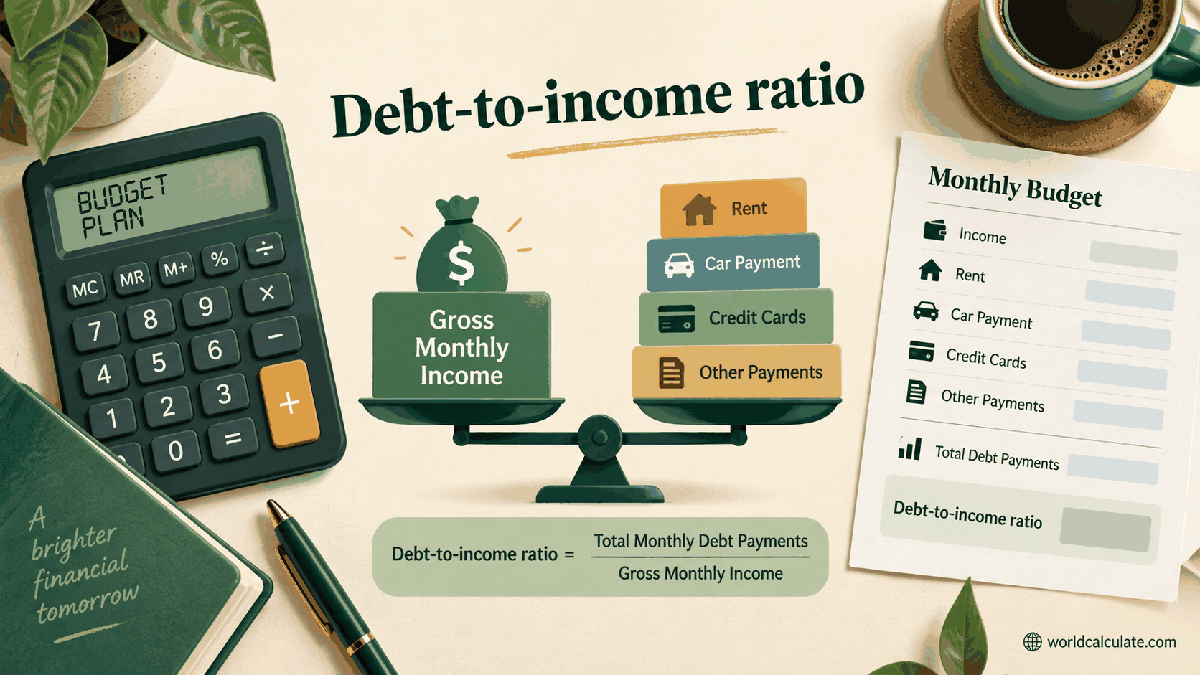
The dividend payout ratio expresses dividends as a percentage of net income for one selected period. This calculator also returns the complementary retention ratio: 100 percent minus payout. Enter dividends and positive net income using the same currency, period, share basis, and reporting convention. A 20 percent payout means the entered dividends equal one fifth of the entered net income under this arithmetic. It does not predict future dividends, judge sustainability, measure investor return, or recommend a security. A payout above 100 percent can be mathematically valid when distributions exceed current-period net income. This guide explains the formula, inputs, examples, timing, payout above income, related measures, and the boundary between transparent finance arithmetic and investment advice.

The calculator answers a period comparison: how large are entered dividends relative to entered net income? It divides dividends by net income and multiplies by 100. It then calculates retention as 100 minus payout. With dividends of 2,000 and net income of 10,000, payout is 20 percent and retention is 80 percent. The two percentages are complementary under the formula, but they describe accounting amounts rather than cash balances or investor outcomes.
The word dividends defines the numerator. Use the distribution amount required by the statement or analysis, and decide whether the convention is declared, paid, or another period measure. The calculator does not have separate fields for declaration and payment dates. It cannot determine whether a distribution belongs to the selected period. That preparation decision must be made before entry and recorded with the result.
Net income defines the denominator. It is the current-period income figure under the chosen statement convention, not revenue, operating cash flow, or retained earnings. The page requires a positive value because a zero or negative denominator would make this particular payout-and-retention interpretation undefined or misleading. If a loss period matters, analyze it separately rather than forcing it into this ratio.
The result is descriptive. It can help a learner understand how a distribution relates to reported income, or help an analyst compare prepared scenarios. It does not identify why a company paid a dividend, whether the payment came from current cash, or whether a policy should change. Those questions require facts outside the two-input contract.
Dividends are distributions to shareholders under the chosen reporting convention. Enter a nonnegative amount in the currency and period used by the net-income input. If the source reports dividends per share rather than a total, do not enter the per-share number as though it were a total. Convert to the intended total or use a clearly defined per-share analysis outside this page.
Declared and paid dividends can occur at different times. A company may declare a distribution in one period and pay it in another, with a payable recorded between them. This page does not decide which event belongs in the numerator. Follow the statement or question being analyzed and label the convention. A mathematically accurate quotient can still answer the wrong timing question.
Other owner distributions may not be dividends in every entity type. Partnerships, cooperatives, sole proprietorships, and other structures can use draws or distributions with different equity presentation. The page uses the dividend label and should not be used to rename every owner transaction without checking the reporting context.
A zero dividend input is valid and produces zero payout and 100 percent retention when net income is positive. That does not prove all income remained as cash or that no other equity movement occurred. It means the selected dividend amount is zero under the input convention.
Net income is the denominator for the payout ratio. Use the amount for the same period, entity, currency, and reporting basis as dividends. Do not enter sales or cash received. Net income is calculated after the expenses and other items included by the source statement, while cash can move differently because of timing, noncash items, borrowing, asset sales, and working-capital changes.
A positive net-income requirement keeps the ratio contract clear. With zero net income, a dividend payout percentage would divide by zero. With a loss, the sign and interpretation of a payout ratio become different from the ordinary positive-income question. The calculator rejects nonpositive net income rather than turning a loss into an absolute amount or presenting a misleading percentage.
Net income can be reported for a quarter, year, trailing period, or forecast. Dividends must use a compatible period if the quotient is meant to describe that period. A quarterly dividend divided by annual income produces a number, but it is not the same measure as annual dividends divided by annual income. Mixed periods may be useful for a deliberate scenario, but label them clearly.
Use the reported or approved figure that matches the analysis. Do not remove a loss, add back an unusual item, or substitute adjusted earnings without recording the adjustment. If both reported and adjusted cases matter, run them separately and keep their definitions visible.
The formula is payout = dividends / net income x 100. With dividends of 2,000 and net income of 10,000, payout is 2,000 / 10,000 x 100 = 20 percent. Retention is 100 - 20 = 80 percent. The first result is the payout percentage, the second is the complementary retention percentage, and the third repeats net income so the denominator remains visible.
If dividends are 5,000 and net income is 10,000, payout is 50 percent and retention is 50 percent. If dividends are zero, payout is zero percent and retention is 100 percent. These results describe the entered amounts only. They do not say whether the organization has cash, whether a board approved a future payment, or whether retained earnings changed by exactly the same amount.
If dividends are 15,000 and net income is 10,000, payout is 150 percent and retention is negative 50 percent. The ratio is still finite and the page reports it. Distributions can exceed current-period income in a statement scenario because opening balances or other funding facts may exist. The arithmetic does not label that pattern as sustainable or unsustainable.
Scale cancels when both amounts use the same unit. Dividends of 2 and net income of 10 in thousands produce the same 20 percent as 2,000 and 10,000 whole currency units. Mixing 2,000 with 10 in thousands would produce a false 20,000 percent result. Preserve the unit label beside the calculation.
A payout above 100 percent means entered dividends exceed entered current-period net income. It does not necessarily mean the calculator is wrong. A distribution may draw on opening retained earnings, cash reserves, proceeds, borrowing, or other resources. The ratio compares two period amounts and cannot identify the funding source. It reports the percentage and the complementary negative retention result.
The pattern deserves context because current income is not the only balance affecting a distribution. Retained earnings carry prior periods, and cash can be generated or used independently of income. A company may have positive net income but limited cash, or a loss and cash from financing. This page does not reconcile those balances. Use the retained-earnings and cash-flow records when those questions matter.
A payout above 100 percent is not automatically a forecast of future cuts or a sign of policy failure. It may reflect a special distribution, a period mismatch, an accounting adjustment, or a deliberate use of accumulated balances. It may also reflect an input error. Check period, declaration versus payment convention, share basis, and source records before explaining it.
Do not cap the payout at 100 percent. Clipping would hide the relationship the calculator is meant to show and would create a false retention result. The page accepts the finite arithmetic and leaves interpretation to the defined statement context.
The retention ratio returned by this page is the arithmetic complement of payout: 100 minus payout. It represents the share of current net income not represented by the entered dividend amount under the selected formula. A negative retention percentage can occur when payout exceeds current income. This result is not a full statement of changes in retained earnings.
Retained earnings also depends on the beginning balance and other equity movements. A current-period retention percentage does not tell you the ending retained-earnings balance without those additional inputs. Use a retained-earnings roll-forward when the question is beginning balance plus net income minus dividends. Keep the two pages distinct so a percentage is not mistaken for an equity amount.
Retention is not the same as cash retained in a bank account. Net income can contain noncash items, and cash can be used for inventory, debt repayment, equipment, or other purposes. A company can retain income in accounting terms while cash is committed elsewhere. The calculator does not classify or track those uses.
The ratio also does not identify how retained earnings will be used. It may remain in the business, support working capital, fund investment, reduce debt, or be affected by another transaction. A percentage can describe the distribution relationship, but it does not describe management's future allocation.
A payout trend can show that the ratio changed, but the components explain why. Dividends may change, net income may change, or both may move in the same or opposite directions. A higher ratio can result from a larger distribution, lower income, or a one-time period effect. A lower ratio can result from lower dividends, higher income, or a different timing convention.
Use compatible periods. Annual dividends divided by annual net income is a different construction from one quarter's dividends divided by one quarter's income. Trailing figures, special distributions, and partial periods can be useful for a deliberate analysis but must be labeled. Do not compare unlabeled ratios as though they use the same time basis.
Entity comparisons also need compatible share and accounting definitions. An organization may report dividends on a per-share basis while another reports a total. Preferred dividends, minority interests, currency translation, and extraordinary items can affect the numerator or denominator. The page does not normalize these details or fetch market data.
Do not use a payout percentage as a stand-alone stock screen or performance forecast. Investor objectives, price, yield, growth, risk, taxes, and market conditions are not inputs. The calculator is intentionally limited to transparent period arithmetic.
A payout ratio can describe one distribution decision in relation to one net-income figure, but it does not reveal the policy that produced it. A company may follow a stable per-share dividend, a target payout percentage, a residual policy, or an irregular special-distribution approach. The same current-period ratio can arise from any of these patterns. The calculator reports the selected amounts without identifying the policy.
Dividend yield is different from payout. Yield compares a dividend with a market price, while payout compares dividends with net income. A high payout can coexist with a low yield when price is high, and a low payout can coexist with a higher yield under another price. This page has no price field and must not be presented as a yield or return calculator.
Per-share and total-amount bases need care. If dividends are entered as a total but net income is a total, the units align. If an analyst wants a per-share ratio, both numerator and denominator need a compatible share basis, such as dividends per share and earnings per share, subject to the definitions used. Do not mix a total dividend with earnings per share or a per-share dividend with total net income.
Special dividends can make a single period look unlike ordinary policy. A distribution funded from accumulated balances may exceed current net income, producing payout above 100 percent and negative retention. That result may be intentional, a timing effect, or an input issue. Check board records, statement dates, opening retained earnings, and payment convention outside the page before explaining the percentage.
The ratio can be used in a scenario worksheet by changing dividends or net income and observing the arithmetic. Keep reported, planned, and hypothetical cases labeled. A planned payout is not a promise that the board will approve it, and a hypothetical payout is not a recommendation. The page does not model legal availability, liquidity, covenants, taxes, or investor objectives.
A responsible note beside the result states the numerator definition, denominator definition, period, currency or share basis, and whether the amounts are reported, declared, paid, adjusted, or projected. This makes it possible to compare the calculation with a retained-earnings roll-forward and cash records without assuming that the three views are identical.
The payout ratio is sensitive to the period convention for both inputs. A declared dividend may be recorded before payment, and a special distribution may belong to a different policy discussion from a regular quarterly dividend. Net income may be reported for a quarter, year, or trailing period. Choose a deliberate pair and label it. The page cannot align dates or classify a distribution on your behalf.
A reported ratio can also differ from a planned ratio. A plan may use forecast earnings and a proposed distribution, while a report uses approved historical amounts. Do not mix the two in one trend without marking the transition. If a scenario is useful, run it separately and state that it is hypothetical. The calculation is transparent when readers can tell which numbers are actual and which are assumptions.
Cash and retained earnings add important but separate context. Dividends can reduce retained earnings while cash payment occurs later, and cash can be available from a source unrelated to current income. A payout percentage therefore cannot establish whether a distribution is funded or whether retained earnings changed by the same amount. Use the corresponding roll-forward and cash records when those questions matter.
Shareholders may care about dividend yield, growth, price, and risk, but none is calculated here. Yield requires a market price, and an investment conclusion requires objectives and broader evidence. The calculator deliberately avoids fetching prices or presenting a payout percentage as a screen, ranking, or recommendation.
For governance or formal reporting, preserve the board or statement convention, source dates, and any adjustment note with the output. Ask an appropriately qualified accounting or finance professional to review material distributions, tax effects, legal availability, or investment decisions. A precise percentage remains only a narrow accounting comparison.
The page uses two aggregate inputs and two percentage formulas. It does not forecast earnings, predict dividends, measure cash, model taxes, value a security, calculate yield, or decide whether a payout is appropriate. It cannot verify a statement or determine whether a distribution is legally available. Those limits keep the result tied to the stated arithmetic.
Financial figures can be confidential. Avoid entering account numbers, investor identifiers, passwords, tax details, confidential board information, or unnecessary company records into the page. Share only the ratio, components, period, currency, and reporting convention needed for a review. Protect stored results like other financial information.
A common question is whether retention of 80 percent means 80 percent of cash stayed in the bank. No. It is the complement of dividends divided by net income. Another question is whether a 150 percent payout is impossible. No; it can be valid arithmetic, although the context and source records need review. The page does not turn either result into advice.
Use the calculator for finance education, statement analysis, and clearly labeled scenarios. For investment, governance, tax, legal, or formal reporting decisions, review the complete records with an appropriately qualified professional. Keep source definitions attached so the percentage remains interpretable after sharing.
Before comparing or publishing the percentage, repeat the calculation from the recorded dividend and net-income amounts and confirm the period and basis. This last check catches a swapped per-share total, a declaration-versus-payment mismatch, or a copied value from another entity. A reproducible source note is more valuable than an isolated percentage.
Calculate dividend payout and retention ratios from dividends and net income for one period.
Dividend payout ratio = dividends / net income x 100; retention ratio = 100 - payout ratio. The dividend payout ratio expresses entered dividends as a percentage of net income. The companion retention ratio is the remainder after subtracting payout from 100 percent. A result above 100 percent can occur when distributions exceed current-period net income, so the tool reports the arithmetic without judging sustainability or investment value.
Enter Dividends, Net income, then choose Calculate.
Dividends and net income use the same period, currency, share basis, and reporting convention. Net income must be positive for this ratio; the page does not model share counts, taxes, market prices, or investor objectives.
This calculator is part of the WorldCalculate library. Its formula, example, assumptions, input bounds, and output formatting follow the official methodology.
These WorldCalculate collections connect this tool with related questions while keeping each calculation separate and transparent.