
Goal
Share of gross monthly income spent on debt payments, with a plain-English risk verdict.
Worldwide context
Saved once here, used across the site.
Currency changes display only. Country selection guides tax input; no tax rate is guessed.
Share of gross monthly income spent on debt payments, with a plain-English risk verdict.
DTI = debtPayments / grossMonthly x 100; band: <=20 Excellent, <=36 Good, <=43 Acceptable with caution, else High risk.A clearer path to an answer
This page keeps the calculation transparent: define the goal, enter the matching values, inspect the method, and decide what the result means in your situation.
Share of gross monthly income spent on debt payments, with a plain-English risk verdict.
Gross monthly income · Monthly debt payments
DTI = debtPayments / grossMonthly x 100; band: <=20 Excellent, <=36 Good, <=43 Acceptable with caution, else High risk.
Calculate, review the assumptions below, then compare a related tool when the decision needs more context.
Share of gross monthly income spent on debt payments, with a plain-English risk verdict.
Open the Debt-to-Income (DTI) Ratio pageMore finance tools
Download PDFDownload Word (.doc)
Enter your values above and choose Calculate to see the result here.
Calculation map
DTI = debtPayments / grossMonthly x 100; band: <=20 Excellent, <=36 Good, <=43 Acceptable with caution, else High risk.
Bounded, transparent calculation
Your recent runs stay in this browser session only.
Formula: DTI = debtPayments / grossMonthly x 100; band: <=20 Excellent, <=36 Good, <=43 Acceptable with caution, else High risk.
DTI divides recurring minimum debt payments by gross monthly income. Lenders treat 36% and below as comfortable and 43% as the typical upper bound for qualified mortgages.
Worked example: DTI 25.00%; verdict: Good.
The displayed limits are checked before the handler runs. Model-specific domain checks may also reject impossible or non-finite inputs.
Methodology: This calculator follows the WorldCalculate input, formula, precision, and boundary policy. Read the official methodology.
Calculator usage statistics
This section counts anonymous successful Calculate submissions, not unique visitors. Counts and top tools appear only when trusted aggregate data is available; country analysis is shown only under the same condition and reporting threshold.
Answer-first guide
Share of gross monthly income spent on debt payments, with a plain-English risk verdict. Start with one clearly defined goal, enter values in the units shown, and keep the result attached to the assumptions below.
This tool is useful when your question includes dti, debt to income, mortgage readiness. It returns the outputs declared in the calculator contract rather than a live quote, approval, diagnosis, or professional sign-off.
Gross monthly income · Monthly debt payments. Keep the same time period, unit system, and currency wherever the form requires comparable values.
Run the worked example first, compare its output with the page's example, then change one input at a time. This makes an unexpected result easier to trace to a unit, boundary, or assumption.
Need a wider view? Browse Finance Calculators or compare the related tools below. The WorldCalculate methodology explains how formulas, examples, limits, and revisions are reviewed.
DTI = debtPayments / grossMonthly x 100; band: <=20 Excellent, <=36 Good, <=43 Acceptable with caution, else High risk.
DTI divides recurring minimum debt payments by gross monthly income. Lenders treat 36% and below as comfortable and 43% as the typical upper bound for qualified mortgages.
DTI 25.00%; verdict: Good.
Context and background
Finance tools compare amounts across time, rates, and definitions. A payment, balance, return, or ratio is meaningful only when its period, cash-flow timing, and units are stated.
Financial planning developed around making cash flows and performance comparable. WorldCalculate keeps that practical tradition visible through explicit formulas and scenario inputs rather than assuming a universal contract.
Research and review
Researched by Hassan ALRowaie, Founder and editorial researcher at WorldCalculate.
This guide follows the live calculator's declared inputs, formula, worked example, assumptions, validation boundaries, and source-backed methodology. The review date describes editorial review of the calculator explanation; it is not a promise that external facts or rates remain current.
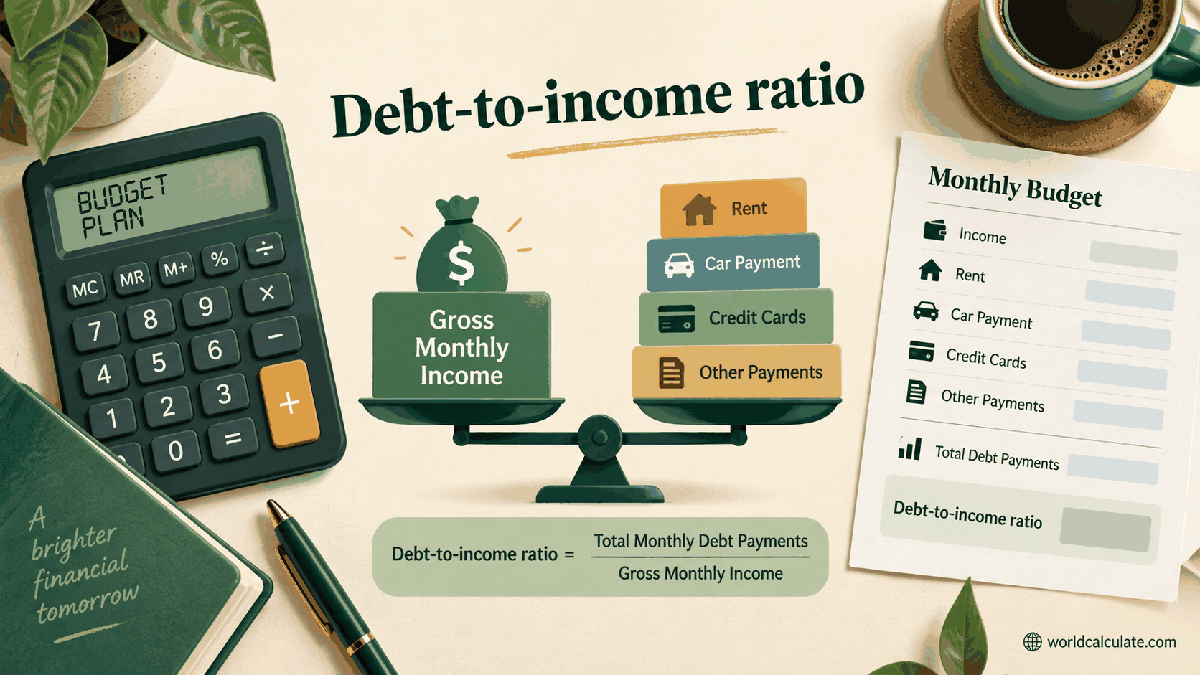
Debt-to-income ratio, usually shortened to DTI, is a simple way to compare recurring monthly debt payments with gross monthly income. It answers a narrow question: what share of the income you report before taxes is already committed to required debt and housing payments? This calculator divides the monthly payment total you enter by your gross monthly income, multiplies by 100, and places the result in one of four plain-language bands. The band is a planning signal, not a lender decision, a personalized approval, or a statement that a particular payment is affordable for you. Use it to understand the arithmetic, test scenarios, and prepare better questions for a lender or financial professional. The quality of the result depends on choosing the same time period, including the right recurring obligations, and remembering what DTI leaves out. The guide below explains each input, the denominator, the calculation, the tool's boundaries, examples at different debt levels, budgeting uses, common mistakes, privacy considerations, and questions visitors often have.
DTI is a ratio of payment obligations to income. It does not compare your total debt balance with your total assets, and it does not measure the interest rate on a loan. Instead, it looks at the recurring amount that must be paid each month and relates that amount to a monthly income figure. If your gross monthly income is 6,000 and your included recurring payments total 1,500, the ratio is 1,500 divided by 6,000, or 25 percent. In plain language, the entered payment obligations equal one quarter of the entered gross monthly income.
The word recurring matters. A debt balance of 20,000 is not automatically a 20,000 monthly obligation. The relevant figure is the payment required under the account's terms for the month being analyzed. A loan with a 350 monthly payment belongs in the numerator as 350. A credit card balance belongs there through the required monthly payment rather than through the entire balance. If a new housing payment is being considered, include the proposed recurring housing amount when the question is forward-looking. State clearly whether you are measuring the current situation or a future scenario.
DTI is useful because it gives very different payment totals a common scale. Someone earning 3,000 and paying 900 has the same 30 percent ratio as someone earning 9,000 and paying 2,700, even though the remaining dollars are different. That common scale helps with comparisons and scenario planning. It does not mean the two households have the same comfort level, because taxes, food costs, insurance, dependents, savings, and local living costs can be very different.
This page is most helpful when you treat the result as a transparent starting point. Read the calculation, check the inputs, and then place the result inside a complete cash-flow review. A lower percentage generally leaves more gross income uncommitted to the listed payments, but a lower percentage is not automatically safe and a higher percentage is not a complete description of a person's finances. The number needs its context attached to it.
The denominator in this calculator is gross monthly income, meaning income before income tax, retirement contributions, health premiums, wage garnishments, and other payroll deductions. If an annual salary is 72,000, a simple monthly conversion is 72,000 divided by 12, or 6,000. Do not enter 72,000 directly into a field that asks for monthly income. Doing so would make the DTI appear twelve times smaller than it is. The income and payment inputs must use the same monthly period.
For hourly or variable pay, use a defensible monthly estimate rather than the most favorable single month. An hourly worker might start with expected hourly rate multiplied by expected hours, then convert the resulting annualized amount to a monthly average. A weekly amount can be annualized using 52 weeks and divided by 12; a biweekly amount can be annualized using 26 pay periods and divided by 12. These conversions are planning tools, not a promise that every lender will accept every source of income in that way.
If income changes from month to month, consider a conservative average and run a second scenario using a lower month. Bonuses, commissions, overtime, seasonal work, tips, self-employment income, and one-time payments may require a documented history or a lender-specific adjustment before they are treated as stable qualifying income. Do not inflate the denominator with income that is unlikely to continue merely to obtain a more reassuring label.
For a household calculation, combine the gross monthly incomes of the people whose debts are also included, and say that the result is a household DTI. For an individual calculation, use that person's income and obligations. Mixing one person's income with a household's payments, or a household's income with only one person's payments, can produce a mathematically valid percentage that answers the wrong question. If income is zero, the ratio is undefined; a positive gross monthly income is required for this calculation.
The numerator is the total of the recurring monthly payments you decide to include. Start with required payments, not the outstanding balances. Common entries include principal-and-interest payments on installment loans, auto loans, student loans, personal loans, and the required minimum payments on revolving credit. Legally required support payments or other recurring obligations may also be relevant to a lender's calculation or to your personal budget. If an obligation has a required monthly amount, note it before deciding whether it belongs in the tool's simplified total.
Credit cards require particular care. For this calculator, use the required monthly payment that represents the recurring obligation you want to measure. Do not enter the entire card balance, and do not assume that paying the full statement balance once makes all future obligations disappear if a balance remains. The payment used in an underwriting worksheet may be based on account statements, a stated minimum, or another qualifying rule. If you are comparing your own budget with a lender's worksheet, use the lender's stated convention rather than assuming the two totals are identical.
Include a proposed housing payment when you are testing whether a future purchase or refinance would change the ratio. A housing payment may include more than principal and interest. Depending on the purpose, the relevant recurring amount can include property taxes, homeowners insurance, mortgage insurance, association dues, and other required housing charges. For a personal budget, include the full expected monthly housing cash cost even when a particular lender categorizes pieces of it separately.
Do not silently treat every expense as debt. Groceries, electricity, phone service, fuel, medical spending, childcare, subscriptions, and ordinary savings contributions are essential to a complete budget, but they are not normally added to a conventional debt-payment numerator simply because they recur. Their exclusion from DTI does not make them unimportant. It means DTI and a full spending plan measure different things. Keep a separate list of those costs so a favorable DTI does not hide an uncomfortable cash-flow position.
Avoid double counting. If a proposed mortgage replaces a current rent payment, a forward-looking debt scenario should generally show the proposed housing cost rather than adding both as permanent obligations. A transition month may temporarily contain both, so a short-term cash-flow plan can show that overlap separately. Likewise, do not add a single payment once as a loan total and again as a category total. Write down each obligation and its treatment before adding the numbers.
The calculator uses one direct formula: DTI = recurring monthly debt payments divided by gross monthly income, multiplied by 100. The division creates a decimal ratio, and multiplying by 100 expresses that ratio as a percentage. With gross monthly income of 6,000 and recurring payments of 1,500, the arithmetic is 1,500 / 6,000 x 100 = 25.00 percent. The units cancel because both amounts are monthly and use the same currency or unit of account.
The denominator is not the amount left after payments. It is the full gross monthly income before the listed debt payments are subtracted. To find the dollars remaining after the entered obligations, subtract the payment total from gross income: 6,000 - 1,500 = 4,500. That leftover figure is useful for a scenario discussion, but it is not the DTI denominator and it is not take-home pay. Taxes and other deductions still have to be considered in a budget.
A zero payment total produces a zero percent DTI when gross income is positive. A larger payment total produces a larger ratio, while a larger income denominator reduces the ratio when the payment total stays fixed. The relationship is proportional, so adding a new 300 monthly payment to a 6,000 gross income increases DTI by 5 percentage points. This makes the tool useful for testing one proposed change at a time before you make a commitment.
Use the unrounded inputs for the calculation and treat the displayed rounding as presentation. At a boundary, a ratio just above 43 percent is different from exactly 43 percent even if a short display format makes both look similar. Preserve the underlying payment and income figures in your notes. The formula is simple, but an incorrectly chosen numerator or denominator will make a precise answer misleading.
This calculator applies four fixed labels to the calculated percentage. A result of 20 percent or less is labeled Excellent. A result above 20 percent through 36 percent is labeled Good. A result above 36 percent through 43 percent is labeled Acceptable with caution. A result above 43 percent is labeled High risk. The comparison includes the boundary on the lower band exactly as written: 20.00 belongs to the first band, 36.00 belongs to the second band, and 43.00 belongs to the third band.
These labels describe the tool's rules, not a personal evaluation of you. Excellent does not mean a loan, rent, or payment is affordable after taxes and everyday expenses. High risk does not mean a person cannot repay an obligation or that a lender must reject an application. The labels are broad educational shorthand for a payment-to-gross-income relationship. They should help you ask what is driving the percentage, not replace a complete review.
The bands are based on common US lending rules of thumb, but real underwriting is not governed by this page's four labels alone. Different products, institutions, programs, and jurisdictions may use different definitions, compensating factors, or limits. A lender can calculate a different DTI from the same household because it may use a different housing payment, income history, treatment of deferred obligations, or payment estimate. Conversely, two applications with the same DTI can receive different decisions for reasons outside the ratio.
Use a band as a prompt for action. If the result is near a boundary, check whether the inputs are complete, whether the payment total includes the proposed housing cost, and whether the income estimate is realistic. If a small payment change moves the label, that is useful scenario information, not a final answer. Make decisions from the detailed numbers and your broader budget rather than trying to manipulate the label by leaving out a recurring obligation.
A ratio is only meaningful when the denominator matches the question. This tool chooses gross monthly income because common DTI conventions compare debt obligations with income before taxes and other deductions. Gross income is easier to standardize across applicants and pay arrangements, but it is not the cash available for groceries, utilities, transportation, or savings. If you replace gross income with take-home pay, you are calculating a different household cash-flow ratio, not the DTI defined by this page.
For example, suppose gross monthly income is 6,000, take-home pay is 4,500, and recurring debt payments are 1,500. The tool's DTI is 25 percent because 1,500 is divided by 6,000. The debt payments equal 33.33 percent of take-home pay. Both figures can be informative, but they answer different questions. The first aligns with the tool's DTI convention; the second shows how much of the deposited pay is committed before other living costs.
Do not use a balance-sheet number as the denominator. Savings, home equity, net worth, or the value of a vehicle can matter to a broader financial review, but none is monthly income. Do not use annual income against monthly payments either. Convert the income to a monthly figure first. If income is paid in a foreign currency or the payments are in another currency, convert both consistently and note the exchange-rate assumption; otherwise the percentage has no coherent unit basis.
A household may also need more than one view. A joint gross-income DTI can show the obligations supported by combined income, while an individual take-home budget can show whether one person could carry the costs during a change in employment. The calculator does not choose that scope for you. Name the people, income sources, and obligations represented by the number so the result is not reused in a context it was never meant to describe.
Housing is often the largest recurring obligation, so it deserves an explicit review. For a mortgage scenario, the expected monthly housing payment may include principal, interest, property taxes, homeowners insurance, mortgage insurance, and association or maintenance charges required by the situation. The exact list depends on the product and the purpose of the calculation. For a personal budget, using the complete expected housing cash cost is usually more useful than looking only at principal and interest.
Rent is a housing expense for household budgeting, even though a lender may classify current rent differently from a proposed mortgage payment. If you are assessing current cash flow, include rent in the payment total you want to monitor. If you are assessing a home purchase, describe whether rent is being replaced by the proposed housing payment. A lender's worksheet may use a front-end housing ratio, a back-end total DTI, or another treatment, so do not assume that an informal rent-inclusive total matches an underwriting form.
Non-housing obligations can include auto loans, student loans, personal loans, installment contracts, revolving credit minimums, and recurring legally required support. Some obligations may have unusual terms. A deferred loan may still receive a payment in a lender's calculation, and a credit card with a variable minimum may be represented differently as the balance changes. A lender or servicer statement is a better source for the payment amount than a guess based only on the balance.
Utilities and ordinary living expenses deserve a place in the household budget even though they are usually outside a conventional DTI numerator. This distinction is one reason a DTI can look comfortable while monthly cash feels tight. A household with low listed debt but high childcare, medical, commuting, or insurance costs may have little flexible cash. Conversely, a household with a higher DTI and low essential living costs may experience the ratio differently. The calculator cannot resolve that tradeoff; your budget has to.
When you add a future housing payment, do not forget expenses that rise with ownership or occupancy. Repairs, maintenance, property taxes, insurance changes, utilities, and transportation may be different from the current situation. DTI can show the effect of the required payment total, but it cannot predict every cost of the housing decision. Keep a separate ownership or occupancy budget beside the ratio.
The easiest way to see the bands is to hold gross monthly income at 6,000 and change only the recurring payment total. With no included payments, the arithmetic is 0 / 6,000 x 100 = 0 percent, so the tool labels the result Excellent. This does not mean there are no living costs; it only means no recurring amount was entered in the selected debt total. It is a useful baseline for a scenario comparison.
At 1,200 of monthly payments, the result is 1,200 / 6,000 x 100 = 20 percent. The tool still labels exactly 20 percent Excellent because the first threshold is inclusive. At 1,500, the result is 25 percent, which falls above 20 and at or below 36, so the tool labels it Good. At 1,800, the result is 30 percent and remains in the Good band. These examples show that the label does not change at every payment increase; the underlying percentage still changes continuously.
At 2,160 of monthly payments, the result is 2,160 / 6,000 x 100 = 36 percent. That exact boundary remains Good. If payments rise to 2,400, the result is 40 percent, which is above 36 and no more than 43, so the tool labels it Acceptable with caution. At 2,580, the result is exactly 43 percent and remains in that same caution band. The phrase with caution is a reminder to inspect the wider budget; it is not a claim that the payment is approved or safe for a particular household.
At 2,700, the result is 45 percent and the tool labels it High risk because it is above 43 percent. At 3,000, the result is 50 percent. Half of the entered gross income would be committed to the entered recurring payments, leaving 3,000 of gross income before taxes and all other spending. That remaining figure is not take-home cash, so it should not be treated as a complete affordability answer.
A different income changes the dollar thresholds. With gross monthly income of 4,000, a 1,000 payment total gives 25 percent, while a 1,600 total gives 40 percent. With gross monthly income of 10,000, a 2,500 total gives 25 percent, while a 4,300 total gives 43 percent. The same payment amount can produce very different ratios at different incomes, which is exactly why the denominator must be identified. The ratio supplies scale; it does not supply the household's full financial story.
For a future scenario, add one proposed payment and compare the before-and-after values. If current payments are 1,500 on 6,000 gross income, current DTI is 25 percent. Adding a proposed 300 recurring payment creates 1,800 of total payments and a 30 percent scenario DTI. Adding 660 instead creates 2,160 and a 36 percent scenario DTI. These comparisons show the mathematical effect of a payment without claiming that any particular person should take on the payment or that a lender will accept it.
Gross income is the convention used by this DTI calculator, but household decisions happen with money that actually arrives after deductions. Taxes, retirement contributions, health premiums, wage withholding, and other deductions reduce take-home pay. A household can therefore have a DTI that appears moderate under a gross-income convention while having little flexible money in the checking account. That is not a contradiction; it is evidence that the two ratios have different denominators and purposes.
After using the calculator, build a take-home budget. Start with reliable net income, subtract required debt payments, housing costs, utilities, food, transportation, insurance, healthcare, childcare, taxes not withheld, and regular savings goals. Add irregular expenses by converting annual or occasional costs into monthly reserves. The amount left after that process is a better starting point for deciding whether a payment fits day to day than the DTI band alone.
Net income is not automatically a better denominator for every question. It can vary because deductions change, and a lender's standard comparison may be designed around gross income. Use gross DTI for the tool's stated purpose and use a net-income budget for household cash-flow planning. Keeping both views prevents a favorable gross ratio from being mistaken for a large amount of spendable cash.
If you are comparing two jobs or two payment options, keep the method consistent. A gross-income DTI for one scenario should not be compared with a net-income burden for another as though they were the same measure. Write the denominator on every worksheet: gross monthly income, take-home monthly pay, or another clearly defined amount. Consistency is more valuable than a single attractive percentage.
There is no single universal DTI worksheet used for every financial product or every institution. A lender may use a front-end housing ratio that focuses on housing costs and a back-end ratio that includes broader recurring obligations. Another process may use a single total ratio with its own definition of the proposed payment. The tool's four bands are a compact educational convention, not a complete representation of every underwriting policy.
Income treatment can vary as well. A lender may verify the length and stability of employment, average variable pay over a history, evaluate self-employment income after allowable adjustments, or exclude income that cannot be documented or reasonably expected to continue. A calculator visitor may enter an estimate for personal planning, but an application review can use a different qualifying income figure. This is one reason an online percentage should never be described as a prequalification.
Debt treatment may differ for deferred student loans, installment debts with a short remaining term, leases, revolving accounts, support obligations, co-signed accounts, or debts that another person pays under acceptable documentation. A lender may also calculate a proposed mortgage payment from taxes, insurance, association dues, and loan terms instead of accepting a user's rough estimate. Ask for the exact payment and income conventions when a formal application is involved.
Other factors can matter alongside DTI, including credit history, available assets, reserves, down payment, loan type, property details, local rules, employment history, and the relationship between payment and income. A lower DTI may help a review, but it cannot override every other condition. A higher DTI may be treated differently when documented compensating factors exist, but the tool does not evaluate those factors. The safe statement is that the calculator helps you understand one ratio and nothing more.
DTI can show how large the listed recurring payment load is relative to the listed gross income. It can help you compare a current month with a future scenario, compare payment options, and identify whether a change in housing or borrowing would materially increase the fixed obligations represented in the calculation. Because the arithmetic is simple, you can also use it as a check against an accidental omission or an unexplained change in a worksheet.
DTI can make a payment change visible in percentage points. On 6,000 of gross monthly income, a new 120 monthly payment changes the ratio by 2 percentage points. That change may be small or meaningful depending on the rest of the budget, but it is transparent. Comparing the percentage before and after a debt is paid off can also show the effect of removing its required payment, provided the payment actually ends and is not merely replaced by another obligation.
DTI can support a conversation. You can use the inputs to ask which housing charges are included, how variable income is averaged, whether a deferred debt receives a qualifying payment, and whether current rent is being replaced or counted in a particular worksheet. A clear list of payments is often more useful than a label alone because it lets another person inspect the assumptions.
DTI can also signal that a separate cash-flow review is needed. A high ratio means a large share of gross income is represented by the selected payments. A ratio near a threshold means small changes in income or payments could change the band. Neither observation predicts a particular outcome, but both are useful prompts to slow down, verify the numbers, and model a less favorable scenario.
DTI does not tell you how much money remains after taxes. It does not include the full cost of food, utilities, transportation, health care, childcare, insurance, repairs, subscriptions, or savings unless you happen to place an item in the payment total yourself. It does not know whether your income is secure, whether your payment rate can change, or whether an emergency would make the monthly plan fail. Those questions require a budget and a review of the underlying accounts.
DTI does not measure the size of your emergency fund, the amount of cash you have available, your assets, your net worth, your credit history, or the interest rate and term of each debt. Two people can have the same percentage with very different balances, rates, reserves, and timing. The ratio also does not distinguish between a payment that ends in three months and a payment that continues for decades unless you analyze the terms separately.
DTI cannot determine whether a property is suitable, whether a payment is fair, whether refinancing will save money, or whether a loan will be approved. It does not evaluate legal documents, tax treatment, insurance coverage, maintenance risk, currency risk, or the consequences of losing income. It also cannot decide what tradeoffs are acceptable for your household. Those are judgment and due-diligence questions, not arithmetic questions.
Finally, DTI cannot validate the truth of the inputs. The calculator can divide the numbers you provide, but it cannot confirm that income is documented, that debts were not omitted, or that a proposed housing amount includes every required charge. A mathematically correct result can still be a poor representation of reality. Accuracy starts before the numbers reach the calculator.
Begin with the question you want the number to answer. For a current snapshot, list the payments you are required to make now. For a future housing or borrowing scenario, add the new payment and remove only an obligation that will genuinely end. Write the gross monthly income and the date or period represented by the estimate. This small preparation step prevents a current DTI from being mistaken for a future DTI.
Next build a net-income budget beside the DTI calculation. Include take-home pay, housing, utilities, food, transportation, insurance, health costs, childcare, taxes, minimum debt payments, flexible spending, and planned savings. Convert annual insurance, repairs, school costs, gifts, and other irregular expenses into monthly reserves. If your income is variable, test a lower-income month and a higher-expense month. A scenario that works only under the most favorable assumptions deserves extra caution.
Use the calculator to test one change at a time. Add a proposed payment, adjust a payment after an actual payoff, or compare two income assumptions. Keep the original scenario so you can see the difference. If the result crosses a band, investigate the reason rather than optimizing for the label. Sometimes the right response is to reduce the payment, increase the down payment, postpone the decision, build reserves, or ask for a formal calculation with verified figures. The page cannot choose among those actions for you.
A budget should also distinguish fixed and flexible costs. DTI focuses on recurring debt payments, while a practical plan needs to know which costs could be reduced during a difficult month and which cannot. Mortgage or rent, insurance, minimum payments, and required support may be less flexible than entertainment or discretionary shopping, but every household's categories differ. The value of the ratio is highest when it is paired with an honest list of both fixed commitments and realistic daily expenses.
Do not borrow simply because a ratio falls within a favorable band. A payment may be mathematically compatible with the band and still prevent you from saving, handling repairs, supporting dependents, or recovering from an income interruption. Use DTI as one guardrail among several: cash reserves, stable income, total monthly surplus, future obligations, and the consequences of a bad month should all be part of the discussion.
DTI is a snapshot unless you update it. Set a regular review point, such as the beginning of each month or after a major change in income, housing, or debt. Recheck the required payment shown on current statements, not the amount you remember from an older month. Record the gross-income period and the payment list each time so that a change in the percentage can be explained rather than guessed.
Monitor both the ratio and the dollars behind it. A higher income can lower DTI even when payments are unchanged, while a lower income can raise DTI without any new borrowing. A paid-off account can lower the numerator, but only after its required payment has actually ended. A new lease, card minimum, support obligation, rate adjustment, or housing charge can raise the numerator even when the total debt balance seems unchanged.
Use a trend as a planning signal, not as a score to chase. A temporarily low ratio based on overtime or a one-time payment may not represent the next year. A temporarily high ratio during a documented transition may need a different conversation than a steadily rising ratio. Keep notes about income stability, payment end dates, and scenario assumptions. If the ratio supports a high-stakes decision, compare your notes with current statements and seek an independent review.
The first common mistake is using net pay in a gross-income DTI. If 4,500 reaches your account but gross pay is 6,000, entering 4,500 as income produces a different ratio and should not be described as the tool's DTI. Keep the net-pay burden as a separate budget measure. The second is entering annual income in a monthly field. Divide annual income by 12 before comparing it with monthly payments.
Another mistake is entering the debt balance instead of the payment. A 12,000 card balance is not a 12,000 monthly payment. Read the required amount from a current statement or loan schedule. The reverse mistake is leaving out an account because its balance feels small. Small payments can matter near a boundary, and omitted obligations make the result less useful even when they do not change the label.
Visitors also sometimes count only loan principal and interest while ignoring recurring taxes, insurance, association dues, mortgage insurance, or other required housing charges in a purchase scenario. Others count rent and a replacement mortgage as permanent obligations even though the rent will end. Decide whether you are showing current cash flow, a transition month, or a stable future scenario. Each can be valid, but they should not be mixed without explanation.
Do not add every recurring household expense to the debt numerator just because it is paid monthly. Utilities and groceries matter to affordability, but adding them to a conventional DTI changes the definition. Instead, use the DTI for its narrow payment comparison and place all other costs in the budget. A custom cash-flow burden can be useful if you name it clearly, but it should not be confused with this DTI.
Mixing household scopes is another error. Combining one person's income with another person's debts may make the ratio look artificially low, while combining only one person's income with shared debts may make it look artificially high. Also avoid optimistic variable-income assumptions, double-counting a payment, rounding income too aggressively, entering a zero denominator, or treating the label as an approval. The safest defense is a written list of sources, obligations, periods, and assumptions.
The calculation needs only a gross monthly income and a monthly payment total. Do not enter account numbers, card numbers, passwords, government identification numbers, full names, employer credentials, or other details that are not needed for the arithmetic. You can often use rounded planning figures for an early scenario, then use exact statement amounts only when you are deliberately checking a formal worksheet. Treat all personal financial figures as sensitive, especially on a shared or public device.
Use the result for your own planning and questions, not to label another person. A ratio is a limited financial measure and does not reveal the whole household situation. Do not share a screenshot or a copied result as though it were proof of eligibility, affordability, or repayment ability. If you discuss the result with a lender, advisor, partner, or family member, include the assumptions and date rather than only the band.
Responsible use also means not omitting payments to obtain a desired label. Leaving out a debt can make a scenario look better while making the planning decision less safe. If the number affects housing, education, a major purchase, debt restructuring, or another consequential choice, verify the payment terms and income assumptions with appropriate documents. Consider professional advice when the situation is complex, but remember that even a professional needs complete and accurate inputs.
This article is educational information about a ratio. It is not individualized financial, legal, tax, credit, or lending advice. You remain responsible for deciding what information to use, what risks to accept, and when to seek a qualified review.
This tool has two numeric inputs and one fixed formula. It does not ask you to classify each debt, identify who owes it, select a loan product, enter a payment end date, or specify how a lender treats an unusual account. It cannot know whether a total includes taxes, insurance, association dues, rent, support, or a proposed payment. You must decide what the payment total represents before relying on the result.
The calculator does not verify income, read account statements, calculate taxes, forecast variable pay, evaluate credit, estimate reserves, or inspect legal terms. It does not test whether a payment is sustainable after a rate change, job loss, illness, repair, dependent-care change, or other event. It does not compare loan costs, determine whether a debt should be refinanced, or assess a property. Those are separate analyses.
The four thresholds are fixed in this tool: 20, 36, and 43 percent. A real lender or program may use another threshold or another definition, and the same institution may apply different rules to different products or applicant circumstances. The tool also uses a broad common-US framing and may not match regional conventions elsewhere. Do not transplant the bands into a formal application without checking the applicable rules.
The output can be arithmetically correct while still being incomplete. Independently recompute the division when the result matters, compare the payment list with current statements, and ask how a formal decision-maker defines income and obligations. For a high-consequence decision, preserve the assumptions, test a less favorable scenario, and obtain the relevant official calculation rather than treating this page as the final authority.
Q: Is DTI based on gross income or net income? A: This calculator uses gross monthly income, which is income before taxes and other deductions. Net income is still essential for a household budget, but a net-income burden is a different ratio and should be named separately.
Q: What should I enter for monthly debt payments? A: Enter the recurring required payment total you want to measure, not the sum of outstanding balances. Review installment loans, auto loans, student loans, personal loans, revolving-credit minimums, required support, and the relevant housing payment. Use the exact convention requested by a lender when comparing with a formal worksheet.
Q: Is rent a debt payment? A: For personal cash-flow planning, rent is a recurring housing obligation and should be included in the total you are monitoring. A lender may treat current rent, a proposed mortgage, and housing ratios differently. State whether the number is a household budget DTI or an attempt to mirror a particular underwriting calculation.
Q: Should I include a proposed mortgage or other new payment? A: Yes, when you are testing the future scenario. Add the expected recurring payment and any relevant required housing charges, and label the result as a projected DTI. Do not present that projection as an approval, and do not add a payment that will replace another obligation as a permanent duplicate without explaining a temporary overlap.
Q: What does 1,500 of payments on 6,000 of gross income produce? A: It produces 25 percent because 1,500 divided by 6,000 times 100 equals 25.00. Under this tool's bands, 25 percent is labeled Good. That label is only the result of the stated formula and thresholds; it does not say that a particular payment fits your complete budget or that a lender will accept an application.
Q: Is 43 percent safe because it is inside the tool's caution band? A: No. The tool includes exactly 43 percent in its Acceptable with caution band, but the label is not a safety guarantee or a recommendation. Check take-home cash, essential expenses, reserves, income stability, and the exact lender convention before making a decision.
Q: Why can two households with the same DTI feel very different? A: DTI uses only selected payments and gross income. It does not capture taxes, rent or housing details outside the selected total, childcare, medical costs, transportation, savings, local prices, dependents, reserves, or income stability. Equal ratios can therefore coexist with very different leftover cash and risk exposure.
Q: Can I enter annual income? A: Convert it to a monthly figure first. Divide a stable annual amount by 12, and use a documented or conservative average for variable income. Entering an annual figure into the monthly income field makes the denominator too large and the result misleading.
Q: What if my income changes every month? A: Use a defensible average for planning, run a lower-income scenario, and note the period and assumptions. A lender may use its own history and verification rules for commissions, overtime, tips, seasonal work, or self-employment. The calculator cannot decide whether variable income is qualifying or stable.
Q: Should utilities, food, and subscriptions be included? A: They should be included in a complete budget because they affect affordability, but they are not normally added to a conventional debt-payment numerator. Keep a separate cash-flow view rather than quietly changing the meaning of DTI.
Q: Does a lower DTI guarantee approval? A: No. DTI is only one ratio and this tool is not a lender. Formal decisions can depend on income verification, credit history, assets, reserves, down payment, property, product rules, local requirements, and the decision-maker's own definitions.
Q: How often should I recalculate? A: Recalculate when income, housing, debt, interest terms, required payments, or household obligations change, and consider a regular monthly review. Keep the payment list and income period with the percentage so you can explain the change.
Q: What happens if gross income is zero? A: The percentage cannot be calculated because division by zero is undefined. Enter a positive gross monthly income that is appropriate to the scenario, or stop and review the financial situation before using a ratio based on income.
Q: Can I use this result as financial advice? A: Use it as educational arithmetic and a planning prompt, not as individualized advice. Verify the inputs, read the limitations, and seek an appropriate qualified review when the result supports a major financial commitment.
Share of gross monthly income spent on debt payments, with a plain-English risk verdict.
DTI = debtPayments / grossMonthly x 100; band: <=20 Excellent, <=36 Good, <=43 Acceptable with caution, else High risk. DTI divides recurring minimum debt payments by gross monthly income. Lenders treat 36% and below as comfortable and 43% as the typical upper bound for qualified mortgages.
Enter Gross monthly income, Monthly debt payments, then choose Calculate.
Inputs use gross (pre-tax) monthly income and recurring minimum debt payments in one currency. Bands follow common US lender rules of thumb, not any single lender's underwriting decision.
This calculator is part of the WorldCalculate library. Its formula, example, assumptions, input bounds, and output formatting follow the official methodology.
These WorldCalculate collections connect this tool with related questions while keeping each calculation separate and transparent.