
Goal
Convert elapsed hours to years, 24-hour days, and minutes using an explicit hours-per-year convention.
Worldwide context
Saved once here, used across the site.
Currency changes display only. Country selection guides tax input; no tax rate is guessed.
Convert elapsed hours to years, 24-hour days, and minutes using an explicit hours-per-year convention.
Years = elapsed hours ÷ hours per modeled year; 24-hour days = hours ÷ 24; minutes = hours × 60; whole years = floor(years); remaining hours = hours − whole years × hours per modeled year.A clearer path to an answer
This page keeps the calculation transparent: define the goal, enter the matching values, inspect the method, and decide what the result means in your situation.
Convert elapsed hours to years, 24-hour days, and minutes using an explicit hours-per-year convention.
Elapsed hours · Hours per modeled year
Years = elapsed hours ÷ hours per modeled year; 24-hour days = hours ÷ 24; minutes = hours × 60; whole years = floor(years); remaining hours = hours − whole years × hours per modeled year.
Calculate, review the assumptions below, then compare a related tool when the decision needs more context.
Convert elapsed hours to years, 24-hour days, and minutes using an explicit hours-per-year convention.
Open the Hours to Years Duration Converter pageMore conversion tools
Download PDFDownload Word (.doc)
Enter your values above and choose Calculate to see the result here.
Calculation map
Years = elapsed hours ÷ hours per modeled year; 24-hour days = hours ÷ 24; minutes = hours × 60; whole years = floor(years); remaining hours = hours − whole years × hours per modeled year.
Bounded, transparent calculation
Your recent runs stay in this browser session only.
Formula: Years = elapsed hours ÷ hours per modeled year; 24-hour days = hours ÷ 24; minutes = hours × 60; whole years = floor(years); remaining hours = hours − whole years × hours per modeled year.
A year can mean a 365-day schedule, an average Gregorian year, a fiscal convention, or a contract-specific service period. This converter asks for the hours-per-year definition instead of hiding it in a default.
Worked example: 8,760 hours equal 1 modeled year, 365 24-hour days, and 525,600 minutes under the 8,760-hours-per-year convention.
The displayed limits are checked before the handler runs. Model-specific domain checks may also reject impossible or non-finite inputs.
Methodology: This calculator follows the WorldCalculate input, formula, precision, and boundary policy. Read the official methodology.
Calculator usage statistics
This section counts anonymous successful Calculate submissions, not unique visitors. Counts and top tools appear only when trusted aggregate data is available; country analysis is shown only under the same condition and reporting threshold.
Answer-first guide
Convert elapsed hours to years, 24-hour days, and minutes using an explicit hours-per-year convention. Start with one clearly defined goal, enter values in the units shown, and keep the result attached to the assumptions below.
This tool is useful when your question includes hours to years calculator, convert hours to years, hours in a year. It returns the outputs declared in the calculator contract rather than a live quote, approval, diagnosis, or professional sign-off.
Elapsed hours · Hours per modeled year. Keep the same time period, unit system, and currency wherever the form requires comparable values.
Run the worked example first, compare its output with the page's example, then change one input at a time. This makes an unexpected result easier to trace to a unit, boundary, or assumption.
Need a wider view? Browse Unit Converters or compare the related tools below. The WorldCalculate methodology explains how formulas, examples, limits, and revisions are reviewed.
Years = elapsed hours ÷ hours per modeled year; 24-hour days = hours ÷ 24; minutes = hours × 60; whole years = floor(years); remaining hours = hours − whole years × hours per modeled year.
A year can mean a 365-day schedule, an average Gregorian year, a fiscal convention, or a contract-specific service period. This converter asks for the hours-per-year definition instead of hiding it in a default.
8,760 hours equal 1 modeled year, 365 24-hour days, and 525,600 minutes under the 8,760-hours-per-year convention.
Context and background
A conversion must name both the source and destination definitions. Regional gallons, miles, temperature scales, and data prefixes can look similar while representing different quantities.
Standardized units make measurements comparable across countries and disciplines. The reliable pattern is a defined factor or relationship followed by clear labeling and sensible rounding.
Research and review
Researched by Hassan ALRowaie, Founder and editorial researcher at WorldCalculate.
This guide follows the live calculator's declared inputs, formula, worked example, assumptions, validation boundaries, and source-backed methodology. The review date describes editorial review of the calculator explanation; it is not a promise that external facts or rates remain current.
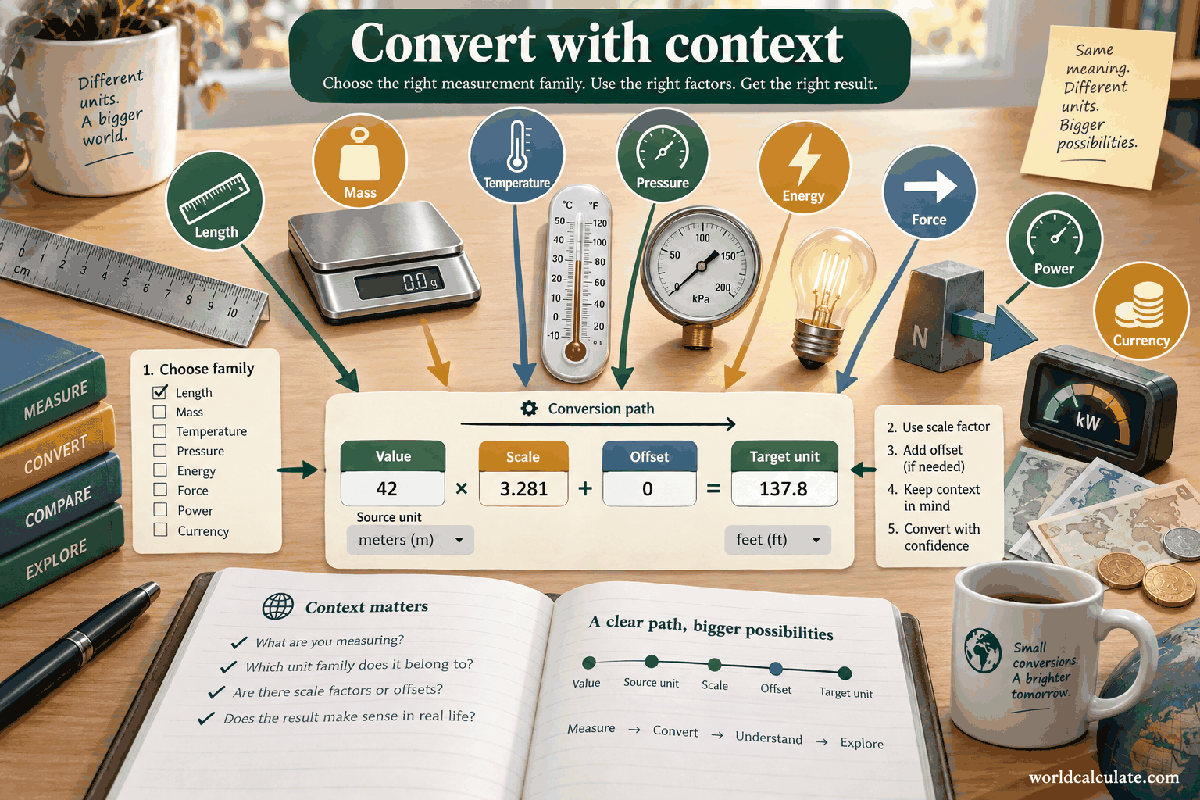
Converting hours to years is only precise after the modeled year is defined. A 365-day operational year contains 8,760 hours, while an average Gregorian year is slightly longer. This page puts that choice next to the input.
The result is an elapsed-duration ratio. It does not calculate someone’s age, a calendar anniversary, or a legal service period from a start date.
A 365-day year contains 365 × 24 = 8,760 hours. With that input, 8,760 hours returns one modeled year and 365 24-hour days.
For long-run planning, an average Gregorian year can be represented with approximately 365.2425 × 24 hours. Entering that value changes the ratio slightly while keeping the arithmetic transparent.
At 8,760 hours and 8,760 hours per modeled year, years = 8,760 ÷ 8,760 = 1. The cross-checks are 8,760 ÷ 24 = 365 days and 8,760 × 60 = 525,600 minutes.
The calculator floors the year ratio and reports the hours left after those whole modeled years. This is useful for schedules where a whole-year block and an outstanding duration need to be shown separately.
A work year might be defined by paid hours, shifts, holidays, or a contract. A fiscal year might not begin in January. Enter the convention used by the source rather than assuming a calendar year.
A 24-hour duration model is not the same as every civil-clock interval. Time zones, daylight-saving transitions, and rare leap-second handling can affect a timestamp difference even when the nominal unit relationship is unchanged.
Dividing by 365 instead of 8,760 when the input is hours, mixing paid hours with clock hours, and comparing a date deadline with a duration ratio are common errors. Label the denominator before calculating.
If the question asks when a period ends, enter the start date and duration in a date-aware tool. This converter is strongest when the problem is explicitly a quantity of elapsed hours.
Convert elapsed hours to years, 24-hour days, and minutes using an explicit hours-per-year convention.
Years = elapsed hours ÷ hours per modeled year; 24-hour days = hours ÷ 24; minutes = hours × 60; whole years = floor(years); remaining hours = hours − whole years × hours per modeled year. A year can mean a 365-day schedule, an average Gregorian year, a fiscal convention, or a contract-specific service period. This converter asks for the hours-per-year definition instead of hiding it in a default.
Enter Elapsed hours, Hours per modeled year, then choose Calculate.
The input is elapsed duration, not a calendar timestamp. Hours per modeled year is an explicit convention supplied by the visitor. 24 hours per day is used for the day cross-check. The year result is a ratio within the selected convention. Whole years use the floor of the nonnegative ratio. Remaining hours are calculated against the selected modeled year. Leap days, daylight-saving changes, time zones, and leap seconds are excluded. A fiscal or employment year may use a different convention and should be entered explicitly. The calculator does not determine service credit, age, legal deadlines, or payroll entitlement. For named dates, use a date interval calculator and preserve the time zone.
This calculator is part of the WorldCalculate library. Its formula, example, assumptions, input bounds, and output formatting follow the official methodology.
These WorldCalculate collections connect this tool with related questions while keeping each calculation separate and transparent.