
Goal
Convert a nonnegative number of US cents into dollars, whole dollars, and remaining cents without applying exchange rates.
Worldwide context
Saved once here, used across the site.
Currency changes display only. Country selection guides tax input; no tax rate is guessed.
Convert a nonnegative number of US cents into dollars, whole dollars, and remaining cents without applying exchange rates.
Dollars = cents ÷ 100; whole dollars = floor(cents ÷ 100); remaining cents = cents − 100 × whole dollars.A clearer path to an answer
This page keeps the calculation transparent: define the goal, enter the matching values, inspect the method, and decide what the result means in your situation.
Convert a nonnegative number of US cents into dollars, whole dollars, and remaining cents without applying exchange rates.
Cents
Dollars = cents ÷ 100; whole dollars = floor(cents ÷ 100); remaining cents = cents − 100 × whole dollars.
Calculate, review the assumptions below, then compare a related tool when the decision needs more context.
Convert a nonnegative number of US cents into dollars, whole dollars, and remaining cents without applying exchange rates.
Open the Cents to Dollars Converter pageMore conversion tools
Download PDFDownload Word (.doc)
Enter your values above and choose Calculate to see the result here.
Calculation map
Dollars = cents ÷ 100; whole dollars = floor(cents ÷ 100); remaining cents = cents − 100 × whole dollars.
Bounded, transparent calculation
Your recent runs stay in this browser session only.
Formula: Dollars = cents ÷ 100; whole dollars = floor(cents ÷ 100); remaining cents = cents − 100 × whole dollars.
The converter handles denomination arithmetic only. It keeps the whole-dollar and remainder lines visible so a visitor can use the result for a price, savings jar, classroom exercise, or cash-counting check without confusing it with currency exchange.
Worked example: 1,250 cents = 12.50 US dollars, made up of 12 whole dollars and 50 remaining cents.
The displayed limits are checked before the handler runs. Model-specific domain checks may also reject impossible or non-finite inputs.
Methodology: This calculator follows the WorldCalculate input, formula, precision, and boundary policy. Read the official methodology.
Calculator usage statistics
This section counts anonymous successful Calculate submissions, not unique visitors. Counts and top tools appear only when trusted aggregate data is available; country analysis is shown only under the same condition and reporting threshold.
Answer-first guide
Convert a nonnegative number of US cents into dollars, whole dollars, and remaining cents without applying exchange rates. Start with one clearly defined goal, enter values in the units shown, and keep the result attached to the assumptions below.
This tool is useful when your question includes cents to dollars calculator, convert cents to dollars, how many dollars is cents. It returns the outputs declared in the calculator contract rather than a live quote, approval, diagnosis, or professional sign-off.
Cents. Keep the same time period, unit system, and currency wherever the form requires comparable values.
Run the worked example first, compare its output with the page's example, then change one input at a time. This makes an unexpected result easier to trace to a unit, boundary, or assumption.
Need a wider view? Browse Unit Converters or compare the related tools below. The WorldCalculate methodology explains how formulas, examples, limits, and revisions are reviewed.
Dollars = cents ÷ 100; whole dollars = floor(cents ÷ 100); remaining cents = cents − 100 × whole dollars.
The converter handles denomination arithmetic only. It keeps the whole-dollar and remainder lines visible so a visitor can use the result for a price, savings jar, classroom exercise, or cash-counting check without confusing it with currency exchange.
1,250 cents = 12.50 US dollars, made up of 12 whole dollars and 50 remaining cents.
Context and background
A conversion must name both the source and destination definitions. Regional gallons, miles, temperature scales, and data prefixes can look similar while representing different quantities.
Standardized units make measurements comparable across countries and disciplines. The reliable pattern is a defined factor or relationship followed by clear labeling and sensible rounding.
Research and review
Researched by Hassan ALRowaie, Founder and editorial researcher at WorldCalculate.
This guide follows the live calculator's declared inputs, formula, worked example, assumptions, validation boundaries, and source-backed methodology. The review date describes editorial review of the calculator explanation; it is not a promise that external facts or rates remain current.
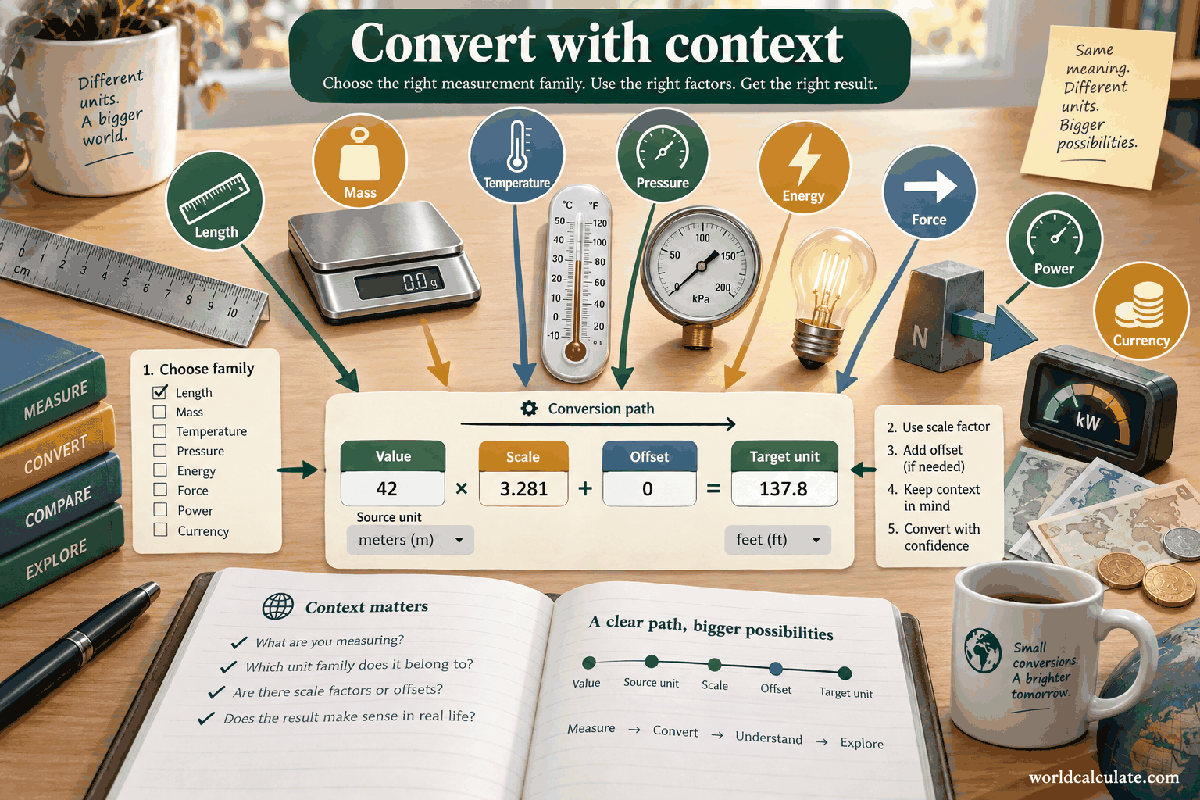
Cents-based money is convenient for storage and arithmetic, while people usually read prices in dollars. This converter bridges the two views and shows the remainder so a number such as 1,250 cents does not become an unexplained 12.5.
US dollar denomination arithmetic uses 100 cents per dollar. Divide the cents amount by 100 to obtain the dollar amount, then keep the remainder when a whole-dollar display is needed.
For 1,250 cents, 1,250 ÷ 100 = 12.50 dollars. The whole-dollar part is 12 and the remainder is 50 cents, which can be displayed as $12.50.
A decimal dollar amount is useful for a receipt or total. A whole-dollar and remainder pair is useful for counting coins, allocating a budget, or explaining the result to a learner. Both lines describe the same amount.
Changing cents to dollars within USD uses a fixed denomination relationship. Changing US dollars to euros, dinars, rupees, or another currency requires an exchange rate and a timestamp, which this page deliberately does not guess.
Many systems store monetary values as integer minor units to avoid binary floating-point surprises. The calculator shows the arithmetic, but software should also define its precision, rounding, and storage type explicitly.
A fractional-cent input can be useful for rates, allocation, or intermediate accounting, but physical cash may not settle at that precision. Keep the mathematical value separate from any point-of-sale rounding rule.
Some places round a cash total to the smallest available coin. That is a transaction policy, not part of converting cents to dollars, and it may differ from card or account settlement.
The page is explicitly labelled USD because cents and dollars are not universal names for a currency’s minor and major units. For another country, confirm the local currency’s denomination and use an exchange calculator only when the question crosses currencies.
The US Mint describes the dollar as the country’s basic money unit and the 100-cent relationship. A historical denomination fact helps explain the convention, but it does not replace current currency or payment rules.
Convert a nonnegative number of US cents into dollars, whole dollars, and remaining cents without applying exchange rates.
Dollars = cents ÷ 100; whole dollars = floor(cents ÷ 100); remaining cents = cents − 100 × whole dollars. The converter handles denomination arithmetic only. It keeps the whole-dollar and remainder lines visible so a visitor can use the result for a price, savings jar, classroom exercise, or cash-counting check without confusing it with currency exchange.
Enter Cents, then choose Calculate.
The input is a nonnegative amount denominated in US cents. One US dollar is treated as 100 cents. The dollar output may contain a fractional part when the cents input is not a whole multiple of 100. Whole dollars use the floor of the nonnegative dollar amount. Remaining cents are the amount after whole dollars are removed. This is not an exchange-rate conversion between currencies. Inflation, purchasing power, fees, taxes, and cash-rounding rules are excluded. The calculator does not identify whether a coin or note is legal tender in a particular transaction. A fractional cent can be entered for accounting or theoretical work but may not be payable as physical cash. The USD label is deliberate; visitors using another currency should use its own minor-unit convention.
This calculator is part of the WorldCalculate library. Its formula, example, assumptions, input bounds, and output formatting follow the official methodology.
These WorldCalculate collections connect this tool with related questions while keeping each calculation separate and transparent.