
Goal
Estimate lawn area, waste-adjusted coverage, sod pieces to order, leftover coverage, and material cost from measured lawn and piece dimensions.
Worldwide context
Saved once here, used across the site.
Currency changes display only. Country selection guides tax input; no tax rate is guessed.
Estimate lawn area, waste-adjusted coverage, sod pieces to order, leftover coverage, and material cost from measured lawn and piece dimensions.
Lawn area = length × width; piece area = piece length × piece width; order area = lawn area × (1 + waste percentage); pieces to order = ceiling(order area ÷ piece area); cost = pieces × price per piece.A clearer path to an answer
This page keeps the calculation transparent: define the goal, enter the matching values, inspect the method, and decide what the result means in your situation.
Estimate lawn area, waste-adjusted coverage, sod pieces to order, leftover coverage, and material cost from measured lawn and piece dimensions.
Lawn length · Lawn width · Length of one sod piece · Width of one sod piece · Waste and trimming allowance · Price per piece · Measurement unit
Lawn area = length × width; piece area = piece length × piece width; order area = lawn area × (1 + waste percentage); pieces to order = ceiling(order area ÷ piece area); cost = pieces × price per piece.
Calculate, review the assumptions below, then compare a related tool when the decision needs more context.
Estimate lawn area, waste-adjusted coverage, sod pieces to order, leftover coverage, and material cost from measured lawn and piece dimensions.
Open the Sod Quantity and Cost Calculator pageMore construction tools
Download PDFDownload Word (.doc)
Enter your values above and choose Calculate to see the result here.
Calculation map
Lawn area = length × width; piece area = piece length × piece width; order area = lawn area × (1 + waste percentage); pieces to order = ceiling(order area ÷ piece area); cost = pieces × price per piece.
Bounded, transparent calculation
Your recent runs stay in this browser session only.
Formula: Lawn area = length × width; piece area = piece length × piece width; order area = lawn area × (1 + waste percentage); pieces to order = ceiling(order area ÷ piece area); cost = pieces × price per piece.
The calculator separates measured area from the extra material needed for trimming and irregular edges. It uses the supplier’s entered piece dimensions instead of assuming one product size, pallet coverage, grass type, or local pricing.
Worked example: Lawn area = 60 m²; waste-adjusted order area = 66 m²; 265 pieces are required and the material estimate is 795 currency units.
The displayed limits are checked before the handler runs. Model-specific domain checks may also reject impossible or non-finite inputs.
Methodology: This calculator follows the WorldCalculate input, formula, precision, and boundary policy. Read the official methodology.
Calculator usage statistics
This section counts anonymous successful Calculate submissions, not unique visitors. Counts and top tools appear only when trusted aggregate data is available; country analysis is shown only under the same condition and reporting threshold.
Answer-first guide
Estimate lawn area, waste-adjusted coverage, sod pieces to order, leftover coverage, and material cost from measured lawn and piece dimensions. Start with one clearly defined goal, enter values in the units shown, and keep the result attached to the assumptions below.
This tool is useful when your question includes sod calculator, how much sod do I need, lawn sod quantity. It returns the outputs declared in the calculator contract rather than a live quote, approval, diagnosis, or professional sign-off.
Lawn length · Lawn width · Length of one sod piece · Width of one sod piece · Waste and trimming allowance · Price per piece · Measurement unit. Keep the same time period, unit system, and currency wherever the form requires comparable values.
Run the worked example first, compare its output with the page's example, then change one input at a time. This makes an unexpected result easier to trace to a unit, boundary, or assumption.
Need a wider view? Browse Construction & Home Project Calculators or compare the related tools below. The WorldCalculate methodology explains how formulas, examples, limits, and revisions are reviewed.
Lawn area = length × width; piece area = piece length × piece width; order area = lawn area × (1 + waste percentage); pieces to order = ceiling(order area ÷ piece area); cost = pieces × price per piece.
The calculator separates measured area from the extra material needed for trimming and irregular edges. It uses the supplier’s entered piece dimensions instead of assuming one product size, pallet coverage, grass type, or local pricing.
Lawn area = 60 m²; waste-adjusted order area = 66 m²; 265 pieces are required and the material estimate is 795 currency units.
Context and background
Construction tools begin with dimensions, coverage, waste, package sizes, or rates. The output is a planning quantity, not a substitute for a site-specific takeoff or structural review.
Material planning applies geometry and unit arithmetic to real spaces. Professional practice adds drawings, tolerances, site conditions, codes, and installation requirements that a compact calculator cannot infer.
Research and review
Researched by Hassan ALRowaie, Founder and editorial researcher at WorldCalculate.
This guide follows the live calculator's declared inputs, formula, worked example, assumptions, validation boundaries, and source-backed methodology. The review date describes editorial review of the calculator explanation; it is not a promise that external facts or rates remain current.
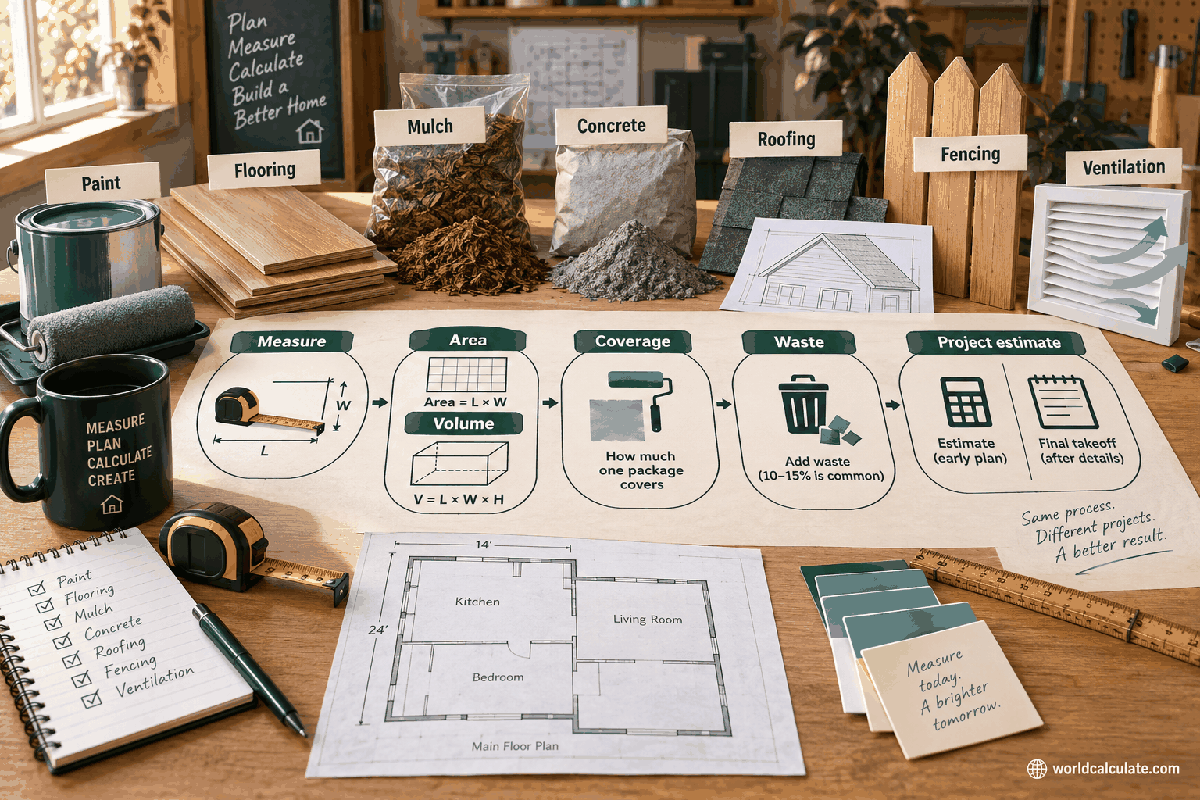
Buying sod is a measurement problem before it is a shopping problem. The lawn has an area, each piece has a coverage area, and trimming and imperfect edges create a reason to order some extra. WorldCalculate keeps those parts visible and lets the visitor use the supplier’s actual piece size and price instead of relying on a hidden regional default.
Enter the lawn dimensions, the actual length and width of one sod piece, a waste allowance, and an optional piece price. The tool returns measured area, order area, pieces, purchased coverage, leftover coverage, square metres, and material cost.
It is an ordering estimate. It does not select the grass species, confirm the supplier’s pallet count, or guarantee that the lawn will establish.
A rectangle is simple: length multiplied by width. For an L-shaped, curved, or irregular lawn, split the site into rectangles or other measurable sections, calculate each area, and add them before entering the total or use a separate area method.
Do not subtract every small irregularity from the order area. Cutting and fitting are exactly why a reasonable waste allowance exists, but the allowance should reflect the shape and installer’s method.
One sod piece covers its length multiplied by its width in the selected unit. The calculator then multiplies the lawn area by one plus the waste percentage and divides by the piece area.
Because pieces are physical items, the result is rounded up with a ceiling function. The purchased coverage and estimated leftover coverage make that rounding visible instead of hiding it in a single quantity.
Sod may be sold as slabs, rolls, pieces, trays, or pallets, and coverage can vary. A remembered standard size can be wrong for the product delivered to a particular region.
Read the supplier’s actual coverage and enter compatible dimensions. If the supplier sells by pallet rather than piece, use the piece calculation as a cross-check and ask for the pallet’s stated coverage before ordering.
Waste covers trimming around curves, fitting edges, staggering seams, damaged pieces, and measurement uncertainty. A simple rectangle with a careful layout may need less than a curved or heavily interrupted area.
The page does not label one percentage as universally correct. Record why the allowance was chosen and revise it if the site survey or installer provides a better estimate.
The cost result multiplies pieces by the entered price per piece. It does not add delivery, pallet deposits, tax, soil amendments, grading, labour, tools, watering, or disposal.
For an international estimate, keep the currency and supplier quote attached to the result. A numeric total without a currency and date is not a reliable project budget.
Healthy sod depends on site preparation, close seams, soil contact, watering, timing, and grass suitability for the climate and site. University extension guidance emphasizes preparation and early care because instant cover can still fail if the roots dry out or the soil is unsuitable.
Use this calculator before ordering, then follow the supplier’s installation instructions and local horticultural advice. The right quantity cannot compensate for poor preparation or a grass type that does not fit the site.
Can I enter feet? Yes; lawn and piece dimensions must use the same selected unit. Does waste mean extra coverage is guaranteed to be usable? No; it is a planning allowance. Why is the piece count higher than area divided by the lawn shape? The tool rounds up to whole pieces and includes the entered waste.
Can I estimate pallets? Not from a universal assumption. Get the supplier’s stated pallet coverage and divide the waste-adjusted order area by that coverage, rounding up, while keeping the piece result as a separate cross-check.
Estimate lawn area, waste-adjusted coverage, sod pieces to order, leftover coverage, and material cost from measured lawn and piece dimensions.
Lawn area = length × width; piece area = piece length × piece width; order area = lawn area × (1 + waste percentage); pieces to order = ceiling(order area ÷ piece area); cost = pieces × price per piece. The calculator separates measured area from the extra material needed for trimming and irregular edges. It uses the supplier’s entered piece dimensions instead of assuming one product size, pallet coverage, grass type, or local pricing.
Enter Lawn length, Lawn width, Length of one sod piece, Width of one sod piece, Waste and trimming allowance, Price per piece, Measurement unit, then choose Calculate.
Lawn and sod dimensions use the same selected unit and describe rectangular areas for this calculation. Irregular lawns should be divided into simple shapes and their areas added before entry. Waste is an entered planning allowance for cuts, seams, damaged pieces, and shape uncertainty. Pieces are rounded up because a fractional physical piece cannot be ordered as one complete piece. Price is entered in the visitor’s currency units and excludes delivery, soil preparation, labour, tax, pallets, and disposal. Sod piece dimensions and supplier packaging vary by product, region, and season. Grass suitability, soil preparation, watering, installation timing, and establishment care require local horticultural guidance.
This calculator is part of the WorldCalculate library. Its formula, example, assumptions, input bounds, and output formatting follow the official methodology.
These WorldCalculate collections connect this tool with related questions while keeping each calculation separate and transparent.