
Goal
Estimate paint needed for a measured surface, selected coats, product coverage, waste allowance, and whole container sizes.
Worldwide context
Saved once here, used across the site.
Currency changes display only. Country selection guides tax input; no tax rate is guessed.
Estimate paint needed for a measured surface, selected coats, product coverage, waste allowance, and whole container sizes.
Base paint = paintable area × coats ÷ product coverage; recommended paint = base paint × (1 + allowance ÷ 100); whole containers = ceiling(recommended paint ÷ container size).A clearer path to an answer
This page keeps the calculation transparent: define the goal, enter the matching values, inspect the method, and decide what the result means in your situation.
Estimate paint needed for a measured surface, selected coats, product coverage, waste allowance, and whole container sizes.
Paintable surface area · Number of coats · Product coverage per litre · Waste and touch-up allowance · Container size
Base paint = paintable area × coats ÷ product coverage; recommended paint = base paint × (1 + allowance ÷ 100); whole containers = ceiling(recommended paint ÷ container size).
Calculate, review the assumptions below, then compare a related tool when the decision needs more context.
Estimate paint needed for a measured surface, selected coats, product coverage, waste allowance, and whole container sizes.
Open the Paint Quantity and Coverage Calculator pageMore construction tools
Download PDFDownload Word (.doc)
Enter your values above and choose Calculate to see the result here.
Calculation map
Base paint = paintable area × coats ÷ product coverage; recommended paint = base paint × (1 + allowance ÷ 100); whole containers = ceiling(recommended paint ÷ container size).
Bounded, transparent calculation
Your recent runs stay in this browser session only.
Formula: Base paint = paintable area × coats ÷ product coverage; recommended paint = base paint × (1 + allowance ÷ 100); whole containers = ceiling(recommended paint ÷ container size).
This calculator separates measured surface area from the product label coverage and from the practical allowance needed for texture, colour changes, touch-ups, and container rounding. It estimates litres and the number of complete containers without pretending that every surface absorbs paint at the same rate.
Worked example: 8 L before allowance, 9.2 L recommended, and 3 four-litre containers.
The displayed limits are checked before the handler runs. Model-specific domain checks may also reject impossible or non-finite inputs.
Methodology: This calculator follows the WorldCalculate input, formula, precision, and boundary policy. Read the official methodology.
Calculator usage statistics
This section counts anonymous successful Calculate submissions, not unique visitors. Counts and top tools appear only when trusted aggregate data is available; country analysis is shown only under the same condition and reporting threshold.
Answer-first guide
Estimate paint needed for a measured surface, selected coats, product coverage, waste allowance, and whole container sizes. Start with one clearly defined goal, enter values in the units shown, and keep the result attached to the assumptions below.
This tool is useful when your question includes paint calculator, how much paint do I need, paint coverage calculator. It returns the outputs declared in the calculator contract rather than a live quote, approval, diagnosis, or professional sign-off.
Paintable surface area · Number of coats · Product coverage per litre · Waste and touch-up allowance · Container size. Keep the same time period, unit system, and currency wherever the form requires comparable values.
Run the worked example first, compare its output with the page's example, then change one input at a time. This makes an unexpected result easier to trace to a unit, boundary, or assumption.
Need a wider view? Browse Construction & Home Project Calculators or compare the related tools below. The WorldCalculate methodology explains how formulas, examples, limits, and revisions are reviewed.
Base paint = paintable area × coats ÷ product coverage; recommended paint = base paint × (1 + allowance ÷ 100); whole containers = ceiling(recommended paint ÷ container size).
This calculator separates measured surface area from the product label coverage and from the practical allowance needed for texture, colour changes, touch-ups, and container rounding. It estimates litres and the number of complete containers without pretending that every surface absorbs paint at the same rate.
8 L before allowance, 9.2 L recommended, and 3 four-litre containers.
Context and background
Construction tools begin with dimensions, coverage, waste, package sizes, or rates. The output is a planning quantity, not a substitute for a site-specific takeoff or structural review.
Material planning applies geometry and unit arithmetic to real spaces. Professional practice adds drawings, tolerances, site conditions, codes, and installation requirements that a compact calculator cannot infer.
Research and review
Researched by Hassan ALRowaie, Founder and editorial researcher at WorldCalculate.
This guide follows the live calculator's declared inputs, formula, worked example, assumptions, validation boundaries, and source-backed methodology. The review date describes editorial review of the calculator explanation; it is not a promise that external facts or rates remain current.
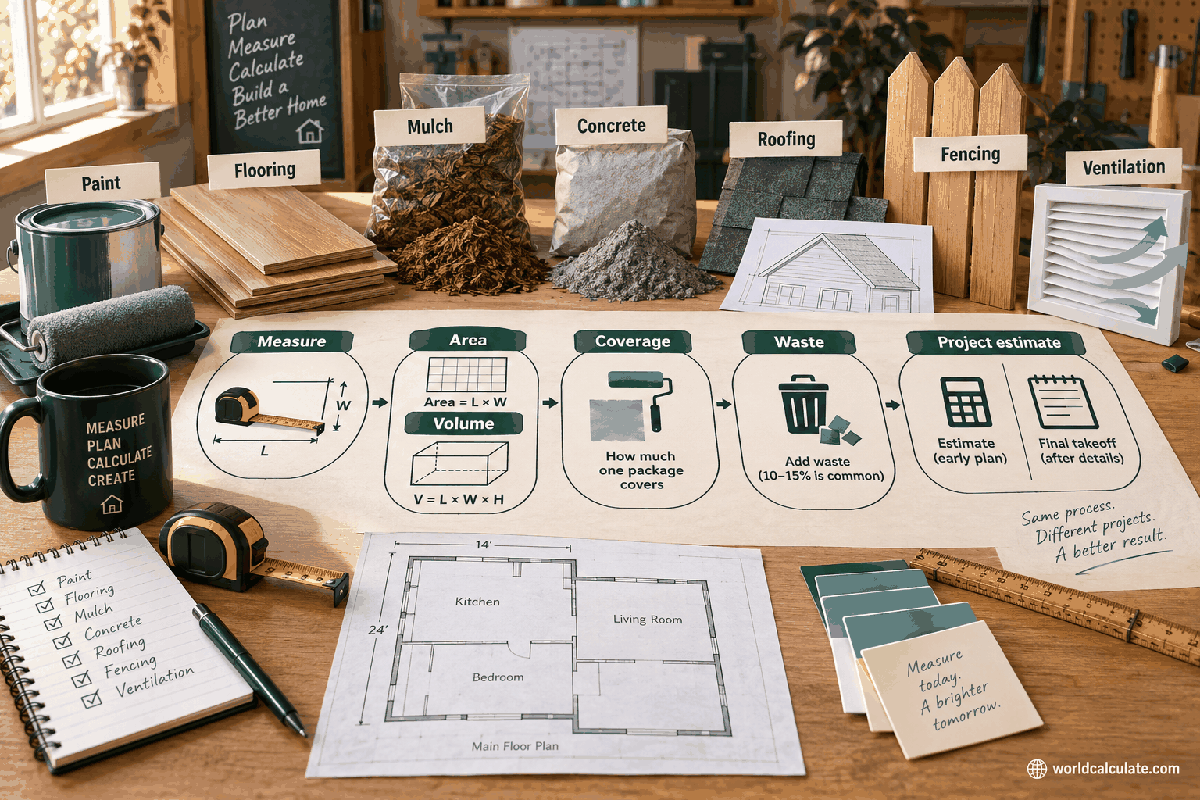
Paint planning looks simple until a room has several walls, a colour change, a textured surface, or a product label that assumes ideal application. This page keeps the calculation visible: measure the paintable area, decide how many coats are intended, read the product coverage, add a deliberate allowance, and round up to containers. The number is a planning starting point; the label, surface condition, preparation method, and local safety rules remain the authority for the actual job.
The calculator answers a practical purchasing question: how much liquid paint should be planned for a measured surface when a chosen number of coats and a product coverage rate are known. It reports the amount before an allowance, the allowance-adjusted recommendation, the number of whole containers, the purchased volume, and the expected remainder. Showing each stage helps a visitor understand why a shelf quantity may be larger than the exact mathematical requirement.
It does not identify a paint product, decide whether a surface is ready, or guarantee a finish. Paint may be used over plaster, drywall, wood, metal, masonry, or an existing coating, and each substrate can change absorption and coverage. Use the result to organize a measurement and product-label decision rather than as a replacement for the manufacturer instructions.
Start with a sketch or room schedule. For a rectangular wall, multiply width by height and record the result in square metres. Add the paintable rectangles, then subtract openings only when those openings will definitely receive no paint. If a door casing, reveal, skirting board, or accent strip will use a different product, keep it in its own line instead of hiding it inside a single area.
Measurement errors often matter more than rounding. A wall that is 4 m wide and 2.5 m high contributes 10 m², while four such walls contribute 40 m² before openings. Measure each wall when the room is irregular, and keep a note of the unit conversion. Mixing centimetres, metres, feet, and square feet can produce a plausible number that is off by a large factor.
Surface area is two-dimensional and is expressed here in square metres. Paint volume is three-dimensional and is expressed in litres. The product label connects them through a coverage rate such as square metres per litre. The core relationship is therefore area divided by coverage, after multiplying the area by the number of coats. Keeping the units visible is a useful error check: m² divided by m²/L leaves L.
The coverage number is not a universal physical constant. It may be a best-case spread rate on a smooth, sealed surface at a specified film thickness. A rough wall, a thirsty new substrate, a dark colour covered by a light colour, or a roller that leaves more texture may need more material. Use the label for the specific product and retain its unit convention.
One coat and two coats are different material plans, not just different preferences. A primer coat, a first finish coat, and a second finish coat may use different products and coverage rates. This calculator treats all entered coats as the same product so the arithmetic stays transparent. If the project has a primer plus two finish coats, calculate the primer and finish paint separately, then create one combined shopping list.
A second coat may improve colour uniformity, hide small variations, and establish the intended sheen, but the product system determines whether it is required. Do not reduce the coat count merely to make the purchase estimate smaller. Record the reason for the chosen count, especially when a contractor, landlord, school, or facilities team needs to repeat the work later.
Coverage may be printed as square metres per litre, square feet per gallon, or a range. Convert the label to the same area and volume units before entering it. When a range is provided, use a conservative value for a porous or textured surface and document why. If the label gives spread rate per container, divide the labelled area by the container volume to obtain a per-litre rate only when the units and product are consistent.
Do not combine a coverage rate from one brand with a different product simply because the numbers look familiar. Primer, ceiling paint, exterior masonry paint, cabinet enamel, and floor coating can have different solids, thickness, and application requirements. A calculator can multiply an input accurately while still producing a poor plan if the input came from the wrong label.
The waste and touch-up allowance is a visible percentage applied after the base amount. An allowance can cover roller loading, tray residue, drips, edge work, small spills, future touch-ups, and uncertainty in the surface measurement. A 15 percent allowance changes 8 L to 9.2 L. The page does not choose the percentage for you because a clean smooth wall and an absorbent textured exterior do not deserve the same planning margin.
An allowance is not permission to ignore preparation or to pour extra paint into a drain. Buy enough for a coherent batch when colour matching matters, but store and dispose of leftovers according to the product label and local waste rules. Record the product name, colour code, batch information, and remaining quantity so future repairs do not rely on memory.
Retail paint is usually purchased in discrete containers. If the recommended amount is 9.2 L and the chosen container holds 4 L, two containers provide only 8 L, so the calculator rounds to three. The purchased volume becomes 12 L and the expected remainder is 2.8 L. That remainder is not wasted automatically; it can become valuable touch-up stock if the container is sealed and stored correctly.
If several container sizes are sold, compare combinations outside the basic estimate. A 10 L container plus a small tin may create less surplus than three 4 L cans, but price, tinting, batch consistency, and availability matter. The calculator intentionally exposes the whole-container result rather than silently selecting a package mix that may not exist in the visitor's country.
Subtracting doors and windows can improve the estimate, but only if they will not receive the same paint. A window opening may still contain a reveal, frame, sill, or trim that needs a separate measurement. Similarly, a wall behind a fixed cabinet may be inaccessible, while a removable appliance may be moved and expose a surface later. Treat each decision as a measurement note rather than applying a blanket subtraction.
Accent walls and feature colours should be calculated separately because one colour may require extra coats or a different coverage rate. The combined shopping list can add the separate container counts, but do not assume that leftover paint from one colour can substitute for another. The page is strongest when its inputs correspond to a clear room schedule.
A textured surface has more actual surface than its flat plan view suggests, and a porous substrate can absorb the first coat. Spraying, rolling, and brushing also deliver different transfer efficiencies and film thicknesses. These effects are why a label may provide a range or separate instructions for different tools. If the product literature offers a coverage value for the exact substrate and method, prefer it over a generic internet estimate.
New plaster, unsealed wood, repaired drywall, masonry, and previously glossy surfaces may need compatible preparation or primer. Paint applied over contamination, moisture, loose material, or incompatible coatings can fail regardless of the litre calculation. If the surface condition is uncertain, solve the preparation question before ordering the finish quantity.
The direction of a colour change matters. A pale colour over a strong dark colour may need a tinted primer or additional coats, while a similar colour on a sound existing coating may cover more easily. The calculator allows the coat count and coverage to reflect that decision, but it cannot evaluate visual hiding or colour metamerism. The product label and a small test area are more informative than a generic coverage promise.
Keep a sample of the approved colour and note the lighting where it was judged. A room can look different in daylight, warm lamps, and shaded corners. This is not a reason to inflate the quantity indefinitely; it is a reason to separate visual approval from arithmetic and to order a consistent, traceable product batch when possible.
Exterior paint planning adds wind, sun, humidity, temperature, dew, and rain exposure to the coverage problem. A wall may be larger than a room wall and may include masonry joints, cladding profiles, or difficult access. The calculator can estimate the area-and-rate arithmetic, but it cannot decide whether conditions are safe or whether the coating will cure correctly. Follow the product technical data sheet and local work-at-height rules.
For an exterior project, divide the estimate by elevation or material so the crew can check progress and isolate a shortage. Record the weather window, substrate condition, primer, finish, and batch. A clean material record is more useful than a single impressive total that cannot explain where the paint went.
Suppose four measured walls total 40 m² after openings are accounted for. The plan calls for two coats, and the product label supports 10 m²/L under the selected conditions. The base amount is 40×2÷10 = 8 L. A 15 percent allowance makes the planning amount 8×1.15 = 9.2 L.
If the available containers hold 4 L, the purchase count is ceiling(9.2÷4) = 3. The purchase is 12 L, leaving an expected 2.8 L after the planned work. The result should be compared with the product label, colour batch needs, primer plan, and storage rules before someone places the order.
Imagine a room with two 5 m by 2.6 m walls, two 3 m by 2.6 m walls, one 2 m by 1.2 m window, and one 0.9 m by 2.1 m door. The gross wall area is 2×5×2.6 + 2×3×2.6 = 41.6 m². If the openings are not painted, subtract 2.4 + 1.89 = 4.29 m² and use 37.31 m² as the wall input.
That subtraction is appropriate only if the reveals and frames belong to another work item. If the door is removed and its surrounding trim is painted, measure that trim separately. The example demonstrates why a precise calculation still depends on a precise definition of the surface rather than on a magical paint constant.
A common mistake is multiplying wall width by height and forgetting the number of walls. Another is entering square feet into a square-metre field or using gallons in a litre container field. A third is using a product's best-case coverage for a rough surface and then treating a shortage as a calculator failure. Write the units beside every measurement before transferring it.
Other mistakes include counting primer as finish paint, subtracting an opening that will receive trim paint, ignoring a second colour, and rounding litres down. The visible steps in this page are designed to expose those decisions. If a result looks unexpectedly small, inspect the units, surface definition, coat count, and coverage source before changing the formula.
A professional material note should include the measured area, coat plan, product name and sheen, coverage source, allowance, container size, container count, colour code, and expected leftover. That note lets another person check the result and makes a future touch-up less dependent on the original calculator session. Keep the receipt and batch information with the project record.
Store paint only as the manufacturer permits. Protect containers from freezing, heat, contamination, and unapproved mixing. Label opened containers with room, colour, date, and substrate. Do not assume an old container remains usable because it still looks liquid; inspect it and follow the product guidance.
Quantity is only one part of a safe paint job. Read the safety data and label, ventilate as instructed, use appropriate personal protection, and keep children and pets away from wet coatings and tools. Older buildings may contain lead paint or other hazards; follow the rules and professional practices that apply in the location instead of relying on a surface calculation.
Preparation can include cleaning, repairing, sanding, deglossing, priming, and allowing the surface to dry. Those steps can change the effective coverage and the number of coats. The calculator should be revisited if the measured surface changes after repairs, but it should not be used to justify skipping a hazard assessment.
Coverage claims, container sizes, decimal separators, and unit conventions differ around the world. A visitor in a country using litres and square metres can enter those directly; a visitor with a gallon label should convert the values first or use a separate worksheet. Currency display and country context do not change this physical estimate.
When a local paint supplier recommends a coverage range, store the low and high scenarios as separate calculations. A range is often more honest than a false single precision. Use the conservative scenario for ordering when a second trip is expensive, and use the actual remaining quantity to improve the record for the next room.
Before buying, confirm the surface list, units, openings, number of coats, product coverage, allowance, and container size. Check whether primer, trim, ceiling, doors, and accent colours belong in separate calculations. Confirm that the product is compatible with the substrate and that the selected finish is available in the needed container and colour batch.
After the job, record the actual litres opened, litres left, number of coats achieved, and any unusual absorption or touch-up. Comparing the estimate with the outcome improves the next local estimate without pretending that one room establishes a universal rate. The best calculation is one that remains understandable when another person reads it months later.
Primer is often part of a coating system but it is not automatically interchangeable with finish paint. A new drywall repair may need a sealer or spot primer, while a sound previously painted wall may not. Calculate the area and coverage of each product separately if the technical data sheet calls for different coats or spread rates.
Combining primer and finish litres into one total can make a shopping list look complete while hiding the wrong container type. Keep product, colour, sheen, and coat purpose beside each line. The calculator can be run more than once; separate runs usually produce a more useful material record than a single blended number.
A ceiling may use a different finish and may be harder to reach, so measure its plan area separately. Floors, doors, cabinets, radiators, metalwork, and trim often require specialist coatings and preparation. Do not put every square metre in the same field simply because the surfaces are in one room.
A separated estimate also makes progress easier to check. If the ceiling uses 12 m²/L and the wall product uses 10 m²/L, the label assumptions remain visible. This protects the project when a supplier substitutes a product or when a later repair uses a smaller container.
When a label gives a range, create a low-coverage and high-coverage scenario. The low-coverage scenario represents a rough, porous, or difficult surface; the high-coverage scenario represents a smooth, prepared surface. Compare the resulting container counts rather than choosing an arbitrary midpoint with false certainty.
Scenario planning is especially helpful when a shortage would delay a job or when leftover storage is difficult. Record which scenario was selected and why. The page's waste field can represent uncertainty, but it should not be used to conceal a coverage range that deserves to be shown explicitly.
Colour matching can vary between batches, even when the label code is the same. If a large continuous surface is being painted, ask the supplier whether the required quantity should be tinted or mixed together. The container count from this page helps estimate scale, but it cannot confirm tint availability, batch consistency, or stock.
If a project is divided into phases, keep a reserve for future touch-ups and record the batch. A smaller later purchase may be visually different. Plan the storage location, lid seal, and label before opening a container so the leftover is useful rather than an unidentified residue.
After the first room, compare the predicted base litres with the actual amount used before allowance. Note surface texture, tool, primer, number of coats, temperature, and colour change. That local observation can inform another room with the same product and substrate, but it should not be copied to a different product without checking the label.
A short post-job record turns the calculator into a repeatable planning tool. Keep the original inputs, the actual opened and remaining volumes, and the final finish quality. If the next project changes any assumption, start a new scenario rather than editing history until it agrees with the outcome.
A large project is easier to audit when it is split into rooms, elevations, stairwells, or colour zones. Run one calculation for each package and keep a combined purchase table. This makes it possible to change one surface measurement without rebuilding every input, and it gives the person applying the paint a clear handoff.
Package-level records also expose unusual consumption. If one room uses much more than the others, investigate texture, repairs, tool choice, or a spill rather than averaging the difference away. A single total can hide a local problem that needs attention before the next coat.
Corners and edges are part of the paintable surface but often consume more time and material than a flat-area model suggests. Brush loading, masking, ladder movement, and repeated cut-in work can justify an allowance or a separate detail estimate. Do not invent extra square metres for difficult access; record the reason for the chosen allowance.
When access equipment or another trade controls the work area, schedule the paint package around that constraint. A mathematically sufficient volume cannot solve a blocked wall or an unsafe reach. The estimate should travel with the work sequence, surface readiness, and access note.
A small remainder can be more valuable than a perfectly minimized purchase because future scuffs and repairs rarely occur on the day of the original job. Keep a labelled touch-up container if the product remains usable and the colour batch matters. Record where it was used so a later repair does not apply the wrong sheen to a nearby surface.
If the paint will be consumed across a long project, plan when to blend or box containers as the product instructions permit. Do not mix incompatible products, add water or thinner without guidance, or assume a stored remainder can be revived. The purchase estimate is only the start of a material-control record.
Before placing an order, compare the recommended litres with the available container sizes and the product's shelf or tinting constraints. Confirm that the surface area includes every intended coat and that the allowance is documented. Check whether separate primer, trim, ceiling, exterior, or accent-colour entries are needed.
After purchase, preserve the calculator inputs, label coverage, colour code, batch, and receipt. After application, update the record with actual use and remaining stock. This closes the loop between the formula and the real room, allowing the next estimate to be more informed without turning one job into an unsupported universal rule.
Estimate paint needed for a measured surface, selected coats, product coverage, waste allowance, and whole container sizes.
Base paint = paintable area × coats ÷ product coverage; recommended paint = base paint × (1 + allowance ÷ 100); whole containers = ceiling(recommended paint ÷ container size). This calculator separates measured surface area from the product label coverage and from the practical allowance needed for texture, colour changes, touch-ups, and container rounding. It estimates litres and the number of complete containers without pretending that every surface absorbs paint at the same rate.
Enter Paintable surface area, Number of coats, Product coverage per litre, Waste and touch-up allowance, Container size, then choose Calculate.
The entered area is already reduced to the surface that will actually be painted. All coats use the same product and the same coverage assumption. Coverage is entered from the selected product label or a documented local estimate. The allowance is a planning margin and is not a guarantee of zero shortage. Container sizes are treated as available whole units and are not mixed automatically. Primers, sealers, thinners, tinting, drying time, and product compatibility are outside the arithmetic. Windows, doors, openings, trim, ceilings, and separate colours should be measured as separate areas when their treatment differs. The result is a purchase estimate, not a specification or application instruction.
This calculator is part of the WorldCalculate library. Its formula, example, assumptions, input bounds, and output formatting follow the official methodology.
These WorldCalculate collections connect this tool with related questions while keeping each calculation separate and transparent.