
Goal
Calculate working capital as current assets minus current liabilities for one reporting date.
Worldwide context
Saved once here, used across the site.
Currency changes display only. Country selection guides tax input; no tax rate is guessed.
Calculate working capital as current assets minus current liabilities for one reporting date.
Working capital = current assets - current liabilities.A clearer path to an answer
This page keeps the calculation transparent: define the goal, enter the matching values, inspect the method, and decide what the result means in your situation.
Calculate working capital as current assets minus current liabilities for one reporting date.
Current assets · Current liabilities
Working capital = current assets - current liabilities.
Calculate, review the assumptions below, then compare a related tool when the decision needs more context.
Calculate working capital as current assets minus current liabilities for one reporting date.
Open the Working Capital Calculator pageMore business tools
Download PDFDownload Word (.doc)
Enter your values above and choose Calculate to see the result here.
Calculation map
Working capital = current assets - current liabilities.
Bounded, transparent calculation
Your recent runs stay in this browser session only.
Formula: Working capital = current assets - current liabilities.
Working capital is the difference between current assets and current liabilities. The result keeps the currency of the entered balance-sheet amounts and can be positive, zero, or negative. It is one accounting measure and does not summarize every timing, quality, or financing condition.
Worked example: Working capital is 150000.00.
The displayed limits are checked before the handler runs. Model-specific domain checks may also reject impossible or non-finite inputs.
Methodology: This calculator follows the WorldCalculate input, formula, precision, and boundary policy. Read the official methodology.
Calculator usage statistics
This section counts anonymous successful Calculate submissions, not unique visitors. Counts and top tools appear only when trusted aggregate data is available; country analysis is shown only under the same condition and reporting threshold.
Answer-first guide
Calculate working capital as current assets minus current liabilities for one reporting date. Start with one clearly defined goal, enter values in the units shown, and keep the result attached to the assumptions below.
This tool is useful when your question includes working capital, current assets, current liabilities. It returns the outputs declared in the calculator contract rather than a live quote, approval, diagnosis, or professional sign-off.
Current assets · Current liabilities. Keep the same time period, unit system, and currency wherever the form requires comparable values.
Run the worked example first, compare its output with the page's example, then change one input at a time. This makes an unexpected result easier to trace to a unit, boundary, or assumption.
Need a wider view? Browse Business Calculators or compare the related tools below. The WorldCalculate methodology explains how formulas, examples, limits, and revisions are reviewed.
Working capital = current assets - current liabilities.
Working capital is the difference between current assets and current liabilities. The result keeps the currency of the entered balance-sheet amounts and can be positive, zero, or negative. It is one accounting measure and does not summarize every timing, quality, or financing condition.
Working capital is 150000.00.
Context and background
Business tools separate revenue, cost, margin, markup, cash, time, and return so a planning decision can be checked one layer at a time.
Management accounting and operating analysis use ratios and thresholds to make business performance easier to compare. The right denominator and period are part of the answer, not a hidden detail.
Research and review
Researched by Hassan ALRowaie, Founder and editorial researcher at WorldCalculate.
This guide follows the live calculator's declared inputs, formula, worked example, assumptions, validation boundaries, and source-backed methodology. The review date describes editorial review of the calculator explanation; it is not a promise that external facts or rates remain current.
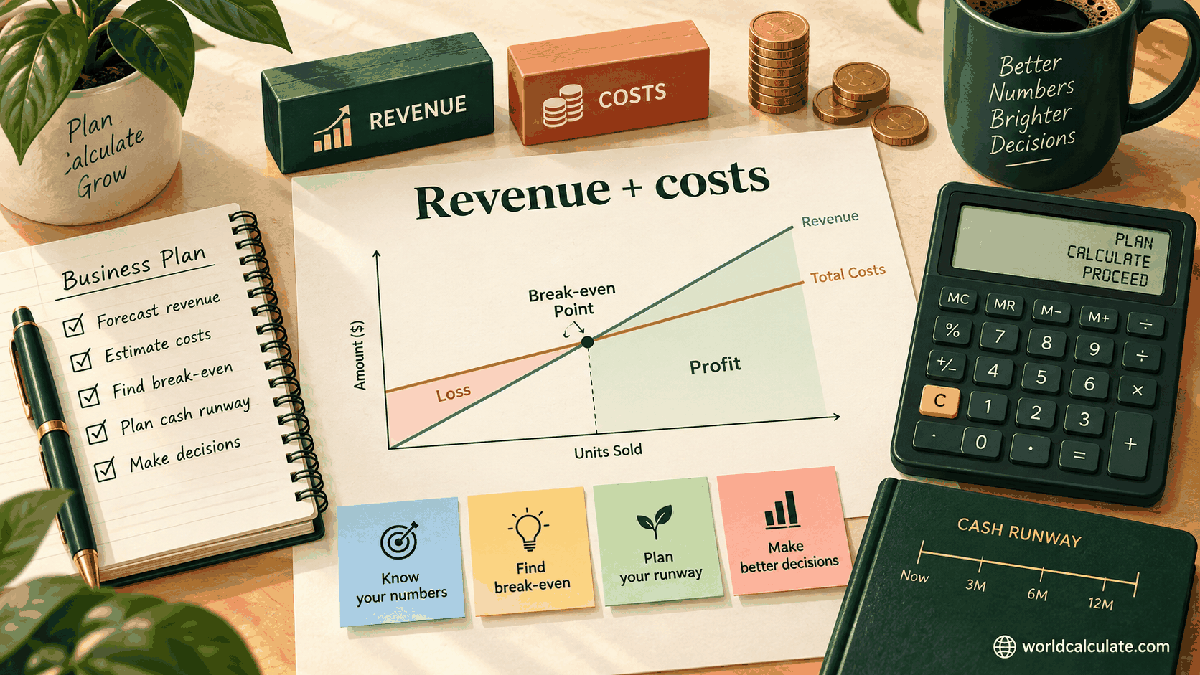
Working capital is the difference between current assets and current liabilities. It is a compact way to describe the net amount of resources and obligations inside a chosen short-term operating boundary. Enter the two totals for the same date, currency, and reporting scope, and this calculator subtracts liabilities from assets. A positive result does not prove that bills can be paid, and a negative result does not by itself prove failure. The quality of the interpretation depends on what the source classifies as current and when the resources and obligations will actually move. This guide explains the two inputs, the formula, timing, examples, related ratios, and responsible limits. It is an accounting calculation, not a lending, solvency, or business-health verdict.
The calculator answers one question: what is the difference between the current assets and current liabilities entered for one reporting date? Current assets are resources expected to be used, sold, collected, or converted within the operating boundary chosen by the reporting framework. Current liabilities are obligations expected to be settled within that comparable boundary. The page does not identify the accounts or decide their classification. It applies the subtraction after you have prepared the totals.
With current assets of 250,000 and current liabilities of 100,000, working capital is 150,000. That result keeps the currency and scale of the inputs. It is not a percentage, a cash balance, or an amount that can necessarily be withdrawn. Current assets can include receivables or inventory, and current liabilities can have different due dates and payment conditions. The subtraction gives a net amount, while the underlying composition explains how usable that amount may be.
Working capital is often useful for comparing a balance-sheet boundary across dates or scenarios. A change can reflect more cash, slower collections, additional inventory, new short-term borrowing, accrued expenses, or many other movements. The calculator has no transaction history and cannot attribute a change to one cause. Record the source totals and date beside the result so a later reviewer can distinguish a business change from a classification or data-entry change.
The word current should not be treated as a universal number of days in every context. Operating cycles differ, and reporting rules define current classification. This page assumes your source already made that decision. Do not include a long-term asset merely because it might be sold soon, or exclude a current obligation because it is inconvenient. Use the classification in the relevant records and document exceptions outside the form.
Current assets commonly include cash and cash equivalents, trade receivables, inventory, and other resources classified within the short-term operating boundary. The exact list depends on the statement and reporting rules. Use the total from the same balance sheet or worksheet that supplies current liabilities. Do not mix a bank balance from today with a statement total from month-end unless the difference in timing is deliberate and clearly labeled.
Receivables are not identical to cash. They may be due soon, but collection depends on customers, terms, disputes, credit risk, and processing time. Inventory is also not a guaranteed cash amount. It may require sale, may change in value, or may be needed to continue operations. Working capital includes these assets when they are classified as current because the measure is broader than immediate cash. A separate cash ratio is better when the narrow liquid subset is the question.
Prepayments and other current assets can also affect the total without being freely spendable. A prepaid service may reduce a future bill but cannot necessarily pay a supplier today. Tax receivables, short-term investments, and restricted amounts may have their own conditions. The calculator does not remove or discount them. If a presentation or analysis needs a narrower definition, prepare that adjusted current-assets total separately and record the adjustment instead of implying that the default subtraction made it.
Keep sign conventions simple for the input. Current assets are entered as a nonnegative total. Contra-assets and allowances should already be treated according to the source statement. Do not enter a negative asset total to represent a liability or use a negative number as a shortcut for an unrecorded adjustment. If the source is uncertain, resolve the accounting question before relying on the numerical result.
Current liabilities commonly include accounts payable, accrued expenses, short-term borrowings, and the current portion of longer-term obligations. Use the classification and measurement in the source statement. A liability due in the operating cycle may be current even when the exact payment date is not known. Conversely, a long-term obligation is not made current by placing it in a short-term planning list. The calculator cannot make that judgment from a label alone.
Timing within the current boundary still matters. Two organizations can show the same current liabilities while having very different due-date patterns. One may owe most of its total next week, while another may have a smoother schedule. Working capital does not reveal that distribution. If the decision concerns near-term cash, pair this result with a dated cash-flow schedule and the payment terms of the actual obligations.
Do not subtract expenses that have not become liabilities under the chosen records merely because they are expected. A forecast bill can be relevant to a cash plan, but it is not automatically part of a reported current-liabilities total. Likewise, do not omit accrued obligations because no invoice has arrived if the source accounting process recognizes them. Follow the statement convention and keep forecasts separate from reported balances.
Enter current liabilities as a nonnegative total. The subtraction handles the relationship between the two totals; it does not need a negative liability input. If a source includes a contra or offsetting balance, use the source's net presentation or document the gross-to-net treatment before entering the total. A transparent preparation note prevents later readers from guessing what was included.
The formula is direct: working capital = current assets - current liabilities. If assets are 250,000 and liabilities are 100,000, the result is 150,000. If assets are 80,000 and liabilities are 100,000, the result is negative 20,000. No percentage conversion occurs. The result has the same currency and scale as both inputs, so a statement reported in thousands produces a working-capital result in thousands.
Both amounts must use the same date and unit. Adding current assets in dollars to current liabilities in thousands of dollars can create a one-thousand-fold error while still producing a number that looks plausible. The same issue occurs when a foreign-currency balance is mixed with a domestic-currency balance. Convert and label first. The calculator intentionally does not guess exchange rates, rounding rules, or reporting scales.
The result is computed from the unrounded numeric values entered in the form. A display rounded to two currency places may differ by a small amount from a spreadsheet that keeps more decimals. Keep full precision when comparing periods or reconciling to source totals. If a report requires a particular rounding convention, apply it at the presentation step and state that convention rather than changing the underlying inputs.
The subtraction is not a margin. A working-capital amount of 150,000 does not mean 150,000 percent or 150,000 days. To compare organizations of different size, an analyst may use another ratio such as current assets divided by current liabilities, but that is a separate calculation with a different interpretation. Do not convert this result into a ratio by attaching a label the page did not calculate.
In the default example, current assets are 250,000 and current liabilities are 100,000. The subtraction gives 150,000. If the source currency is dollars, the result is 150,000 dollars. If the source uses euros, the result is 150,000 euros. The calculator does not choose the symbol. The important evidence is the prepared totals, the reporting date, and the fact that both amounts belong to the same current boundary.
Consider a second case with current assets of 90,000 and current liabilities of 90,000. Working capital is zero. This means the totals are equal, not that the entity has no resources or no obligations. The assets may turn into cash at different times, and liabilities may be due at different dates. A zero result can therefore coexist with substantial activity and significant timing pressure.
In a third case, current assets are 60,000 and current liabilities are 85,000. The result is negative 25,000. The arithmetic indicates that current obligations exceed current assets under the entered classification. It does not identify whether the gap will be covered by future receipts, refinancing, owner support, a longer operating cycle, or another source. The negative sign is useful information, but it is not a standalone conclusion about the organization.
A fourth case can show why the unit label matters. Assets of 420 in a thousands convention and liabilities of 275 in the same convention produce working capital of 145 thousand currency units. If someone reads the result as 145 currency units, the formula was not wrong; the unit context was lost. Preserve the source scale in every exported or shared result.
A single working-capital number is a snapshot. To study change, calculate the same measure at multiple reporting dates using consistent classifications. A rise can come from more cash, more receivables, more inventory, fewer current obligations, or a combination. A fall can reflect collections, inventory reduction, payment of liabilities, new short-term borrowing, or operational pressure. The calculator provides the repeated subtraction; the explanation comes from the underlying statements and transaction records.
Compare like with like. If one period includes a newly consolidated division and another does not, the change may be a scope effect. If one period uses a twelve-month operating cycle and another uses a different classification convention, the series may not be comparable. Note restatements, acquisitions, currency translation, seasonality, and unusual events. A neat trend line can be misleading when the denominator or account boundary changed between dates.
Seasonal businesses need particular care. Inventory may rise before a high-demand period, and receivables may rise after sales. Current liabilities may also change when purchases, payroll, or taxes cluster. A lower working-capital result at one date may be ordinary timing rather than deterioration, while a higher result may represent stock that has not yet sold. Pair the measure with turnover, aging, and cash timing when those facts matter.
Use the same currency and rounding approach for the comparison. Store the raw input values, not only the displayed result. If a reviewer asks why working capital changed by 25,000, the asset and liability movements provide a much more useful answer than the final subtraction alone. This page is a starting point for that explanation, not a full trend-analysis system.
The current ratio divides current assets by current liabilities, while working capital subtracts them. A large organization may have a large positive working-capital amount but a modest current ratio, and a small organization may have a small amount with a similar ratio. The measures answer different scale questions. This calculator intentionally returns the amount only so it does not pretend to have calculated a percentage or a threshold.
The cash ratio narrows the asset side to cash and cash equivalents before dividing by current liabilities. It can be useful when the question is immediate liquid coverage rather than the broader current-asset boundary. Receivables and inventory may be important to operations but are not identical to cash. Use the cash-ratio tool or another defined measure when that narrower question matters, and keep the inclusion rules visible.
Working capital is also different from cash flow. A sale on credit may increase receivables and income without immediately increasing cash. Paying a payable reduces cash and liabilities together. Borrowing can increase cash and a liability at the same time. These relationships explain why a balance-sheet difference cannot replace a period cash-flow analysis. Use explicit operating, investing, and financing flows when the question concerns movement over time.
A common question is whether positive working capital means an organization is healthy. The answer is no. Quality, timing, concentration, access to credit, supplier terms, and future commitments all matter. Another question is whether negative working capital is always bad. Not necessarily; some business models collect cash before paying suppliers. The calculator deliberately avoids those generalizations and reports the entered subtraction.
Begin by writing down the statement date, entity boundary, currency, scale, and current-account classification used for both totals. Then enter the numbers without changing them to reach a preferred answer. Read the amount and compare it with the source. This simple sequence separates arithmetic from preparation. It also gives another person enough context to reproduce the result instead of receiving an unexplained positive or negative balance.
If working capital is positive, inspect what creates it. A large receivables balance may not collect quickly, and inventory may be essential stock rather than surplus. If current liabilities are concentrated in the next few days, a positive amount may not cover the immediate schedule. The calculator cannot rank asset quality or payment urgency, so those facts must be reviewed alongside the subtraction.
If working capital is zero or negative, preserve the sign and inspect the operating cycle. The result may be normal for a business that collects cash before paying suppliers, or it may reveal a mismatch between dates, classifications, and obligations. Do not add a financing source, remove an asset, or recast a liability merely to make the output positive. A documented source adjustment is different from an unexplained edit.
For repeated reporting, store the two raw inputs and the resulting difference for each date. Compare the movement in current assets with the movement in current liabilities before describing a trend. A change of 25,000 could come from collections, inventory purchases, debt maturity, accrued payroll, consolidation, or a correction. The number identifies the net movement, while the statement explains its cause.
When this measure is used in a meeting or worksheet, label it as working capital and keep related ratios separate. A reviewer should be able to tell whether a figure is a currency amount, a current ratio, cash ratio, or forecast cash balance. Clear labels reduce the risk that a correct result is reused outside the question it was prepared to answer.
The page needs only two aggregate amounts, but financial totals can still be sensitive. Avoid entering account numbers, customer names, passwords, tax identifiers, bank credentials, or unnecessary personal details. Use a private setting appropriate to the information and share only the result and context needed for the decision. An aggregate working-capital figure may reveal the condition of a business or household, so treat it as financial information even when no account list is shown.
This calculator does not prepare a balance sheet, validate a ledger, classify accounts, adjust for collectability, model due dates, forecast receipts, or evaluate financing. It cannot determine whether an asset is liquid, whether a liability will be refinanced, or whether a result meets a lender's policy. A correct subtraction can still be unsuitable for a decision if the source totals are incomplete or measured under incompatible rules.
If a result will support a material purchase, borrowing decision, covenant discussion, audit, restructuring, or public report, review the source records with an appropriately qualified person. Keep the date, currency, scale, classification convention, and unusual adjustments attached to the calculation. If the result conflicts with actual bank timing or obligations, investigate the records rather than assuming the tool or the cash schedule must be wrong.
Use working capital for transparent arithmetic, education, and a first-pass comparison of a defined current boundary. Stop at the boundary when you need a recommendation, a solvency determination, a forecast, a legal conclusion, or an assurance opinion. The page is useful because it is narrow. Its limitation prevents one subtraction from being presented as a complete financial analysis.
Calculate working capital as current assets minus current liabilities for one reporting date.
Working capital = current assets - current liabilities. Working capital is the difference between current assets and current liabilities. The result keeps the currency of the entered balance-sheet amounts and can be positive, zero, or negative. It is one accounting measure and does not summarize every timing, quality, or financing condition.
Enter Current assets, Current liabilities, then choose Calculate.
Current assets and current liabilities are measured at the same date in one currency. Classification follows the source records supplied by the user; the calculator does not reclassify accounts or judge liquidity.
This calculator is part of the WorldCalculate library. Its formula, example, assumptions, input bounds, and output formatting follow the official methodology.
These WorldCalculate collections connect this tool with related questions while keeping each calculation separate and transparent.